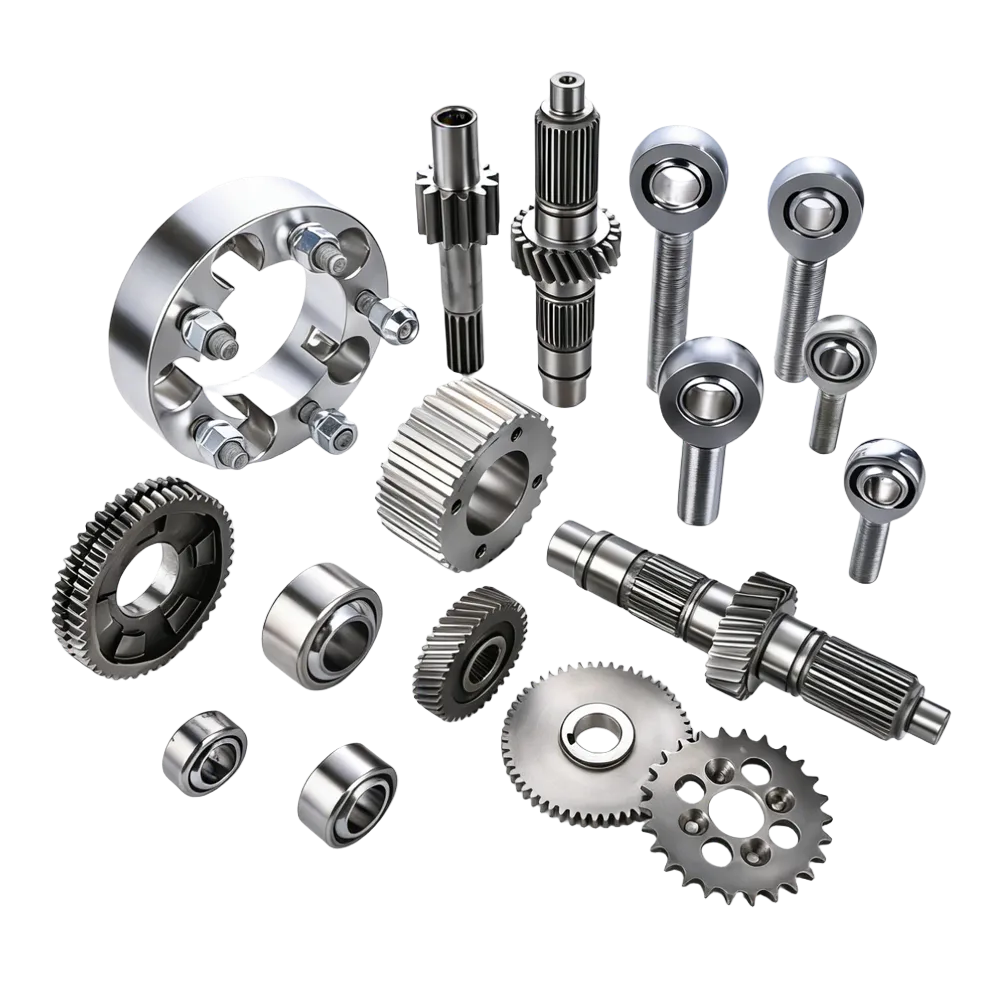

There’s no single best bushing material — the right choice depends on whether you’re prioritizing ride comfort, handling precision, durability, or maintenance-free operation, and those priorities pull in different directions. Rubber, polyurethane, bronze, and engineered plastics each trade off differently on those four axes, and picking the wrong one for your use case (a stiff polyurethane bushing on a daily-driven luxury sedan, for instance) creates a worse result than picking “a good material” that doesn’t fit the application.
Material Comparison
| Material | Best For | Pros | Cons |
|---|---|---|---|
| OEM-style rubber | Daily driving, luxury vehicles, comfort-first use | Quiet, excellent vibration/noise isolation, maintenance-free | Flexes under load (reduces precision), degrades over time from heat, oil, and UV exposure |
| Polyurethane (PU) | Performance street driving, off-road, heavy towing, track use | Stiffer, less deflection under load, resistant to oil and chemical degradation | Transmits more noise/vibration into the cabin, needs periodic lubrication (see below) |
| Bronze (cast or sintered) | Heavy industrial equipment, high-load machinery, high-heat applications | Handles heavy loads and shock without deforming; sintered bronze is self-lubricating | Fully rigid — zero flex or vibration dampening, requires precise alignment |
| Engineered plastics (Delrin, nylon, PTFE) | Dedicated race applications, lightweight linkages, low-friction sliding parts | Lightweight, wear-resistant, very low friction, corrosion-proof | Harsh and noisy for daily driving; can become brittle under heavy impact loads |
The Hidden Cost of Polyurethane: Lubrication
Polyurethane bushings often need periodic re-greasing with a lubricant specified by the manufacturer. If they are left dry, they may squeak or bind. Rubber bushings generally need no periodic lubrication after installation.
Choosing by Use Case
- Daily driver / commuter: Stick with quality OEM-style rubber. Modern vehicles are engineered around rubber’s compliance characteristics, and it keeps the ride quiet and predictable.
- Sporty street car: Polyurethane in strategic locations only — sway bar end links, rear trailing arm bushings, differential mounts are common candidates. A full-vehicle polyurethane conversion often makes a street car feel harsher than expected.
- Track / competition: Polyurethane, or spherical/solid bushings where class rules and NVH tolerance allow.
- Truck / off-road / heavy towing: Polyurethane can make sense given the higher loads involved, but application-specific fitment still matters — this isn’t a blanket “always upgrade” recommendation.
- Heavy industrial machinery: Bronze or engineered plastics, chosen by load, temperature, and precision requirements rather than ride comfort — this is a different decision axis than automotive suspension entirely.
Brands Commonly Referenced in This Space
No single brand is universally “the” choice — these are options that come up repeatedly across independent sources for their respective category, not a ranked list:
Polyurethane performance bushings: SuperPro, Powerflex, Whiteline, Energy Suspension, and Prothane are the names that show up most consistently across sources for this category.
OEM-style rubber replacements: Lemförder and Meyle are common choices for European-vehicle applications. Moog has broad availability, though sourced feedback notes quality varies by specific product line within their catalog — worth checking the specific part rather than assuming uniform quality across their range.
The Short Version
- Comfort and isolation matter most → rubber.
- Stiffness, precision, and load resistance matter most → polyurethane (budget in the lubrication maintenance).
- Heavy industrial load, high heat, minimal flex tolerance → bronze.
- Maximum precision, minimum weight, race-only use → engineered plastics.
- Not found in research: independently verified lab test data (durometer specs, wear-cycle counts) comparing these materials head-to-head — the comparison above reflects consistent multi-source consensus on relative characteristics, not lab-measured figures. Treat the pros/cons as directionally reliable, not as spec-sheet numbers.
Related reading: Bushing vs. Bearing vs. Sleeve vs. Reducer: What’s the Real Difference? · How Much Does It Cost to Replace Bushings?