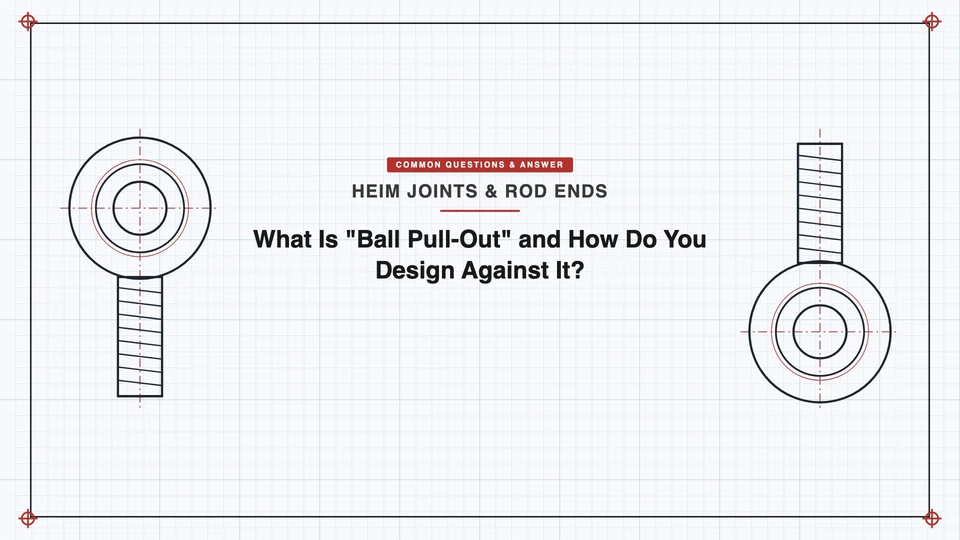
Ball pull-out in rock crawler suspension is the failure mode where a spherical component — a rod end’s ball, a ball joint stud, or any similar ball-and-socket connection — gets forced out of the structure that’s supposed to contain it, under axial or shear load. The same underlying mechanism shows up in automotive ball joints, electronic solder-ball connections, and press-fit assemblies generally; applied to a rod end specifically, it’s what happens when the race or liner around the ball wears or deforms enough that the ball can escape the joint entirely.
The Failure Chain
Across ball-and-socket designs generally, pull-out follows a consistent sequence:
- An external load pulls or shears in a direction that tends to separate the ball from its retaining structure.
- The retaining geometry — the race’s lip, the housing’s wrap angle around the ball — deforms or yields under that load.
- Once the retaining lip has yielded past a certain point, the ball can physically move past it and escape.
- The connection’s load path is gone — whatever the rod end was linking together is now disconnected.
How This Applies Specifically to a Rod End
The general theory above doesn’t distinguish between a sudden, one-time overload failure and a slow, progressive one — but for a rod end, the progressive path is the more realistic failure story. A rod end’s race or PTFE liner wears gradually over its service life. As that wear progresses, the effective "wrap angle" — how much of the ball’s surface the race is actually gripping — shrinks. A joint that started out fully containing the ball ends up gripping less and less of it. At some point, a single impact load or an unusually hard bump can be enough to push the ball past what little containment is left. In other words: rod end pull-out is typically a wear-then-impact failure, not a single catastrophic overload on a fresh joint. This framing is SYZ engineering interpretation applying the general mechanism to the rod end wear pattern specifically — it’s not a claim from a rod-end-specific study.
Designing Against It
The countermeasures that show up consistently across ball-and-socket engineering, applied to rod end design and selection:
| Design variable | Effect on pull-out resistance |
|---|---|
| Wrap angle / race lip height | Larger wrap angle means more ball surface must deform past the lip before it can escape — direct resistance increase |
| Retaining material yield strength | Higher yield strength in the race/lip material delays the point where it starts to deform under peak load |
| Interference fit between race and housing | Needs to be tuned — too little and the fit doesn’t lock properly; too much and assembly stress or premature wear becomes the problem instead |
| Wear margin / liner thickness | The more liner material available before wrap angle drops to a critical point, the longer the joint stays in its "resists pull-out" state before it doesn’t |
The standard way this gets verified in practice, per interference-fit and ball-joint testing literature, is a slow, controlled axial pull test to failure — loading the joint until it fails and recording both the failure force and the failure mode, rather than assuming a design meets spec from calculation alone.
What This Means for Inspection
Because rod end pull-out is usually a wear-then-impact failure rather than a sudden one, the practical takeaway is that the wear stage is the part you can actually catch. A joint with reduced wrap angle from liner wear will typically show up as increasing play before it ever reaches a pull-out event — which is exactly what a routine play check (see our guide on checking for excessive play in a spherical bearing) is designed to catch ahead of time.
Related reading: How to Check for Excessive Play in a Spherical Bearing · Anatomy of a Rod End: Understanding the Housing, Ball, and Race