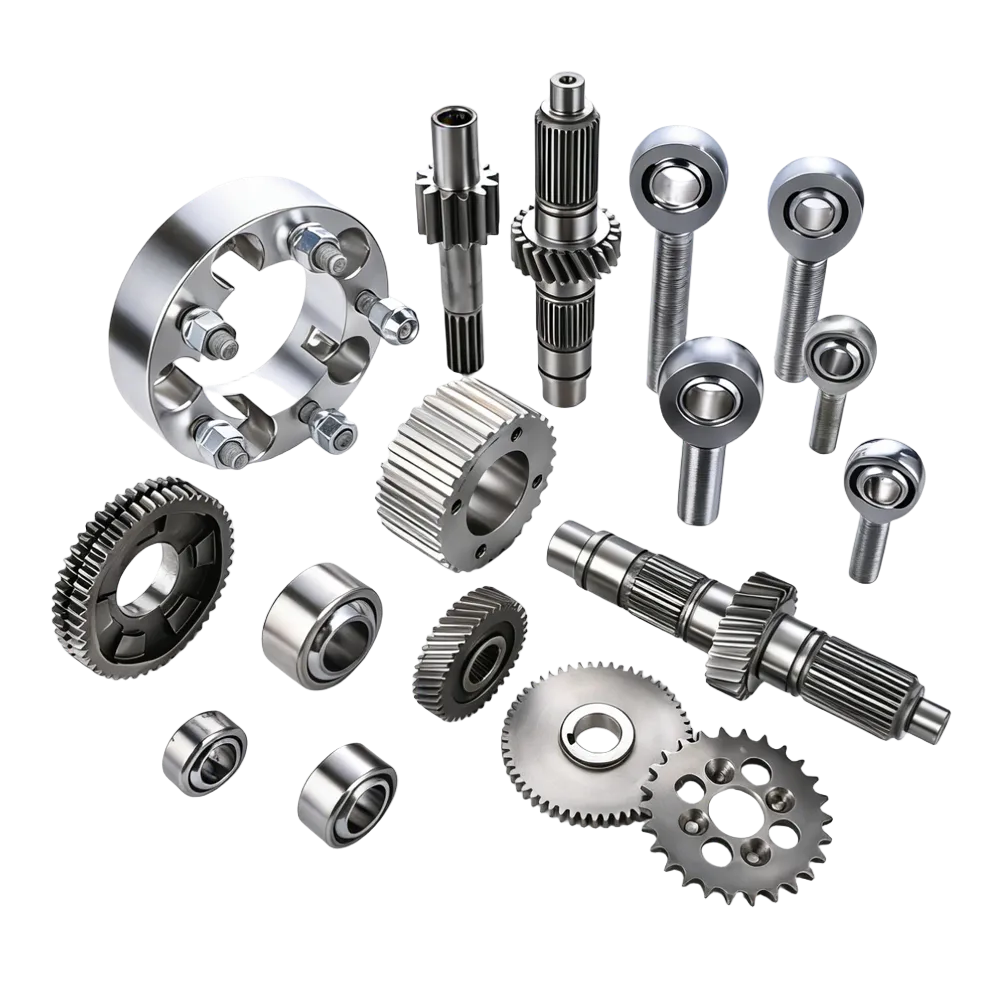

A sprocket and a gear are not the same part with two different names — they’re two genuinely different ways of transferring rotational power, and the visual resemblance (both are round, both have teeth) is where the similarity ends. A gear’s teeth mesh directly with another gear’s teeth. A sprocket’s teeth never touch another sprocket directly — they engage a chain, and the chain does the connecting.
The Core Difference: What the Teeth Touch
That one distinction — direct tooth-to-tooth contact vs. an intermediate chain — is what drives every other difference between the two components: tooth shape, shaft layout, rotation direction, load handling, and maintenance all follow from it.
| Dimension | Gear | Sprocket |
|---|---|---|
| Tooth profile | Involute — precisely shaped for direct meshing | Three-arc/straight-line shape, built to cradle a chain roller |
| Power transfer | Direct tooth-to-tooth contact | Indirect, through a chain |
| Shaft layout | Parallel or non-parallel shafts (with bevel/worm designs) | Parallel shafts only |
| Shaft distance | Short — shafts must sit close together | Long — chain bridges the gap between distant shafts |
| Rotation direction | Two directly meshed gears rotate in opposite directions | Sprockets on the same chain rotate in the same direction |
| Torque/load handling | Higher, thanks to direct contact | Moderate — chain adds a small efficiency loss and a bit of give |
| Precision/cost | Tighter tolerances, higher manufacturing cost | Looser tolerances, lower cost |
| Shock absorption | Minimal — rigid tooth-on-tooth contact | Some — the chain’s slack and lubricated pin joints damp vibration |
| Maintenance | Needs lubrication and alignment, but wears slowly | Needs periodic tension and wear checks; chain elongates over time |
| Typical use | Transmissions, clocks, precision gearboxes | Bicycles, motorcycles, conveyors, final drives |
The Decision Rule
- Choose gears when the two shafts sit close together and you need high torque, high speed, and tight, low-backlash precision in a compact space — a car transmission or a gearbox is the textbook case.
- Choose a sprocket-and-chain system when the shafts are far apart, the layout needs to stay parallel, and you can accept a bit more mechanical give and periodic chain maintenance in exchange for spanning that distance simply and cheaply.
Where this shows up in an off-road drivetrain (original synthesis, not sourced from an ATV/UTV-specific study): the sources behind this comparison are general mechanical-engineering references, not written about off-road vehicles — but the underlying trade-off explains why ATV and UTV final drives are built around a sprocket-and-chain system rather than a gear train. The rear axle sits well behind the engine/transmission output, the shaft layout is parallel, and the chain’s inherent give absorbs some of the shock loading that rough terrain puts into the drivetrain — exactly the profile this comparison describes as favoring a chain drive over direct gearing.
A Word on Rotation Direction — the Fastest Way to Tell Them Apart
If you’re looking at a running mechanism and trying to identify what you’re seeing: two gears meshed directly always spin in opposite directions. Two sprockets connected by the same chain always spin in the same direction. It’s a quick visual check that works even when you can’t get close enough to inspect tooth profile.
One Common Mix-Up Worth Clearing Up
Cyclists often call the toothed wheels on a bike’s cassette or chainrings “gears” — you “change gear” when you shift. Strictly speaking, those components are sprockets, not gears; a bicycle drivetrain has no gears meshing directly anywhere in the chain path. The everyday language is fine for casual use, but it’s worth knowing the distinction if you’re trying to source or discuss the actual part.
For the full anatomy of a sprocket on its own — teeth, pitch, pitch diameter, materials — see What Is a Sprocket?
Related reading: What Is a Sprocket? · What Is a Drive Chain? · What Is Sprocket Pitch? · How Does a Sprocket Work — and How Do You Maintain One?