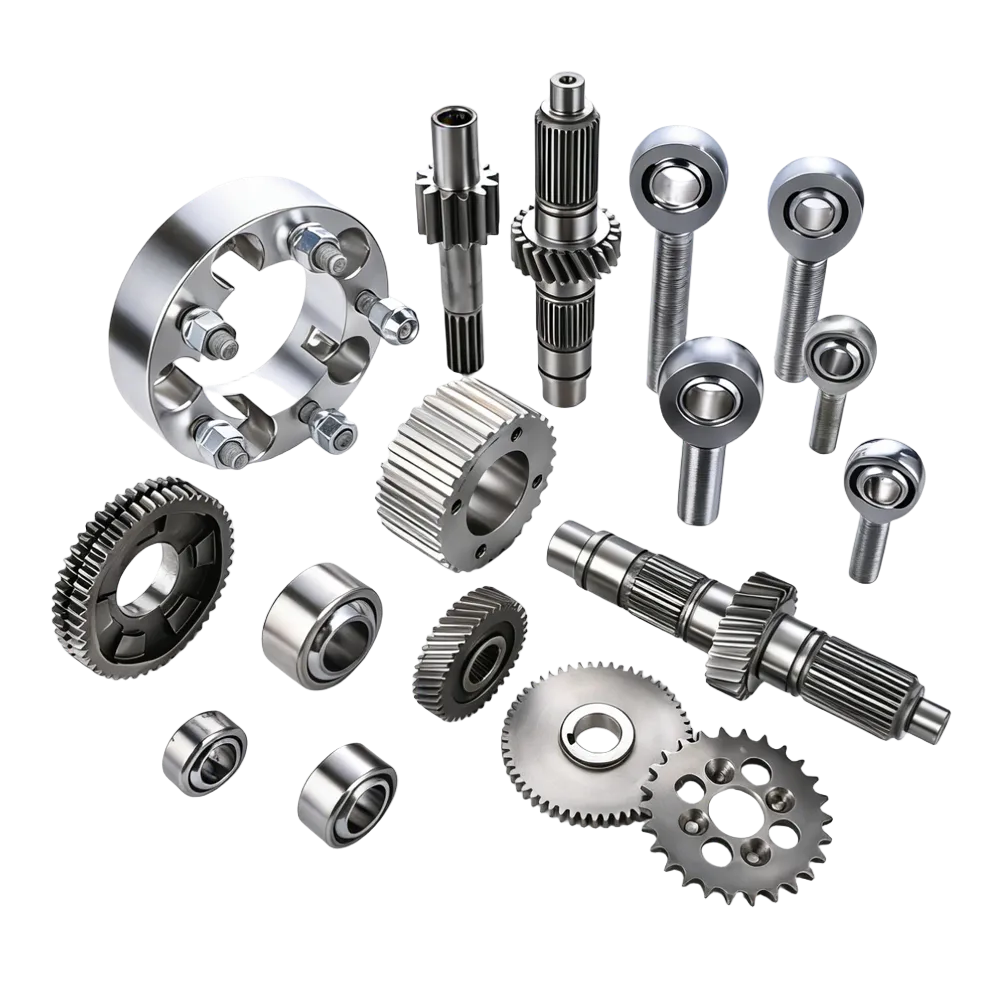
A sprocket is a toothed wheel that engages the links or rollers of a chain to transfer rotational power without slipping. Unlike a gear, which meshes directly with another gear, a sprocket never touches another sprocket directly — the chain does all the connecting. And unlike a pulley, whose smooth rim relies on friction against a belt, a sprocket’s teeth physically lock into the chain, so there’s no slip under load.
The Three-Way Mix-Up: Gear, Sprocket, Pulley
These three components look similar — all are round, all rotate, all have some kind of surface feature — but they transfer power in three different ways:
- Gear: teeth mesh directly with another gear’s teeth. Power moves tooth-to-tooth, no intermediate part.
- Sprocket: teeth engage the links of a chain. Power moves through the chain, from one sprocket to another, and the two sprockets never touch.
- Pulley: a smooth rim (no teeth) drives a belt or rope through friction, not positive engagement.
If you’re looking at a wheel with teeth and trying to figure out which one it is, the test is simple: does it touch another toothed wheel directly (gear), or does it hand off to a chain (sprocket)? For a full breakdown of how sprockets and gears differ in torque handling, tooth shape, and shaft layout, see our companion article on sprocket vs. gear.
What a Sprocket Is Made Of
Every sprocket, regardless of size or application, is described by the same handful of dimensions:
- Number of teeth — the total count around the circumference; this, paired with the mating sprocket’s tooth count, sets the speed and torque ratio of the drive.
- Pitch — the distance from one tooth center to the next, measured along the pitch circle. It must match the chain’s pitch exactly (full breakdown in our sprocket pitch explainer).
- Pitch diameter (P.D.) — the diameter of the imaginary circle running through the centers of the engaged chain rollers.
- Outside diameter (O.D.) — the diameter across the very tips of the teeth; this is what you check against housing or fork clearance.
- Bore and hub — the center hole that mounts to the shaft, and the reinforced boss around it that provides mounting strength.
How a Sprocket Is Built
Sprockets are typically machined from carbon steel, alloy steel, stainless steel, or engineering plastic, depending on the load and environment:
- Carbon/alloy steel — the industrial default. Teeth are commonly induction-hardened to roughly HRC 40–50, which in abrasive-duty applications can extend service life 2–3x over unhardened teeth.
- Stainless steel (18-8/300 series) — chosen for corrosion resistance in washdown, food-contact, or outdoor service.
- Aluminum — hard-anodized for surface hardness, used where weight matters more than long-term wear resistance — mainly racing motorcycles and high-performance bicycles.
- Nylon/engineering plastic — light-duty, self-lubricating, quiet, and rust-proof, but not a substitute for steel under real load.
The blank starts as a cut, stamped, or forged disc, gets CNC-machined for the bore, keyway, and tooth profile, then — for steel parts — goes through heat treatment and a finishing pass (grinding, deburring, coating) before dimensional inspection.
Common Structural Types
Sprockets aren’t one-size-fits-all. A few structural variations show up repeatedly across catalogs:
- Simplex / duplex / triplex — single, double, or triple rows of teeth. A duplex sprocket carries roughly 70% more load than a simplex of the same pitch; a triplex carries roughly 2.5x.
- ANSI hub types A/B/C/D — flat plate with no hub (A), single-side hub (B), symmetrical double hub (C), or offset unequal hub (D) — each trading off axial space against mounting strength.
- Mounting style — finished-bore (pre-bored and keyed, install with set screws), pilot-bore (machine the bore yourself to the exact shaft size), or taper-bush/QD (a split tapered bushing clamps the sprocket to the shaft, and comes off with basic tools — useful where sprockets get swapped often).
- Specialty types — idler sprockets (not driven; they just guide the chain and take up slack), hunting-tooth sprockets (odd tooth count, spreads chain contact across more teeth for slower, more even wear), and segmental-rim sprockets (the worn rim can be replaced in sections without pulling the whole sprocket off the shaft).
Where Sprockets Show Up
- Bicycles and motorcycles — a front sprocket (driven by pedals or engine) pulls a chain that spins a rear sprocket connected to the wheel.
- Industrial machinery — conveyor systems, packaging lines, and assembly equipment use sprockets to drive modular chain or belting.
- Tracked vehicles — tanks, bulldozers, and excavators use heavy sprockets to pull continuous track links, distributing vehicle weight across the track for traction on rough ground.
- Timing systems — inside combustion engines, small sprockets keep the crankshaft and camshaft synchronized.
When to Inspect and Replace a Sprocket
A worn sprocket tooth typically shows a visible change in profile — the tip goes from blunt to sharpened or hooked, instead of the smooth, rounded shape it started with. That shape change is the signal to inspect, not a number on a gauge.
A more concrete checkpoint comes from chain condition: once chain elongation (stretch) reaches roughly 1.5%–3%, that’s generally the point for a full drivetrain inspection — chain and sprockets together, not just the chain. Running a new chain on worn sprockets is a known false economy: it can cut the new chain’s service life by 40–60%, because the worn tooth profile no longer seats the new chain’s rollers correctly.
Where this fits in an off-road drivetrain (original synthesis, not sourced from a specific study): none of the sources behind this article discuss ATV, UTV, or off-road applications specifically — this section applies the general wear-inspection logic above to that context. Off-road drive sprockets run in an environment that accelerates the wear pattern described above: dirt, grit, and water intrusion abrade tooth surfaces faster than a clean indoor conveyor application ever would, which is one reason final-drive sprockets in these systems are specified in hardened steel rather than lighter alternatives, and why the “inspect at every chain service” habit matters more, not less, in this setting.
Related reading: What Is a Drive Chain? · What Is Sprocket Pitch? · Sprocket vs. Gear: What’s the Real Difference? · How Does a Sprocket Work — and How Do You Maintain One?