A uniball — also called a spherical bearing, spherical plain bearing, or monoball — is a bearing where a hardened steel ball sits inside a matching concave race and the two surfaces slide directly against each other, with no rolling elements and no rubber cushioning in between. That direct, ball-on-race contact is what lets it pivot in multiple directions while holding tight, repeatable geometry under load — and it’s why the term shows up constantly in suspension and steering discussions without always being explained.
“Uniball” and “spherical bearing” are the same part described by two different communities. Off-road and motorsport builders say “uniball.” Industrial bearing catalogs and engineering references say “spherical plain bearing” or “spherical bushing.” Neither term is more correct — this article uses them interchangeably, the way the parts themselves are used interchangeably across both worlds.
What’s Actually Inside One
Strip a uniball down and there are three parts:
- Outer race (housing) — the metal shell, machined with a concave spherical bore that the inner ball sits in.
- Inner ball — a hardened spherical bearing surface with a hole through the center for a bolt or shaft.
- Liner — the thin material bonded between the ball and the race that the two surfaces actually slide against. This is the part that determines almost everything else about how the bearing behaves — see the materials section below.
The inner ball can tilt inside the outer race through its working range of motion while the bolted connection through the center stays rigid. That’s the core difference from a rubber bushing, which achieves its range of motion by flexing the rubber itself — a uniball doesn’t flex, it slides, so the geometry of whatever it’s bolted to stays consistent instead of drifting under load.
Two Ways It Comes Packaged
Buying a uniball means choosing between two different physical forms, and mixing them up is a common ordering mistake:
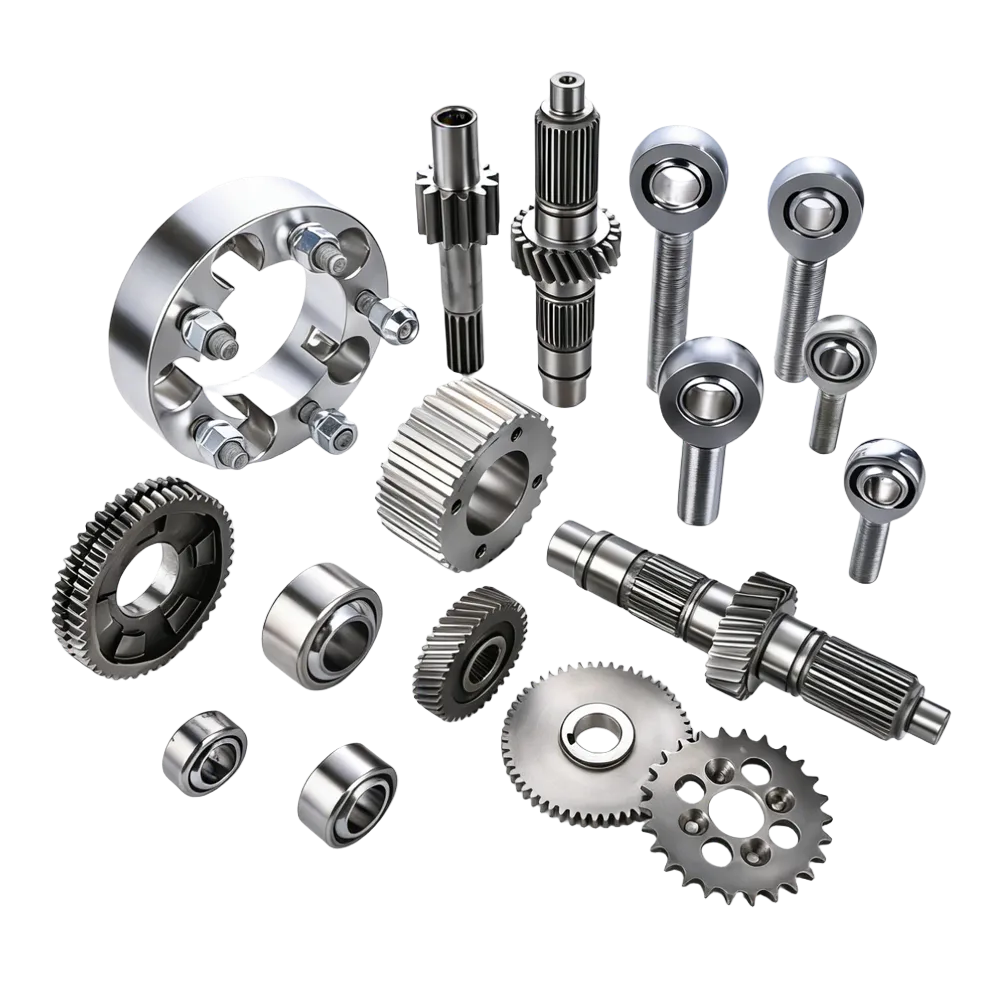
- Rod end (heim joint) — the spherical bearing is pressed into a housing that has an integrated threaded shank, male or female. You thread this directly into the end of a rod or tube and it’s ready to bolt up. This is the form most people picture when they hear “uniball” — it’s the standard for adjustable suspension links, steering linkages, and sway bar end links.
- Bare spherical bearing — no thread, no shank. Just the ball-and-race assembly, sized to press into a weld cup (a bearing housing you weld onto a control arm or bracket yourself). This is how uniballs show up in fixed structural applications like upper control arms, where the housing is part of the arm itself rather than a separate threaded fitting.
If a supplier quote or spec sheet just says “uniball” without specifying which of these two forms, that’s worth clarifying before ordering — the bore diameter might match, but a rod end won’t fit where a bare bearing and weld cup are needed, and vice versa.
Material Choice Is a Load-vs-Maintenance Trade-off
Three liner materials cover most of what’s on the market, and each one trades load capacity against maintenance differently:
| Liner material | Load capacity | Maintenance | Typical use |
|---|---|---|---|
| Steel-on-steel | Highest — handles the most static load and shock | Needs regular grease; runs dry and it wears fast, develops play and noise | Heavy-duty off-road, high-shock applications |
| PTFE composite | Lower load/speed limits | Self-lubricating — runs dry for its service life, no grease fitting | Daily-driven or lower-load applications where zero maintenance matters more than peak capacity |
| Sintered bronze | Mid-range | Partial self-lubrication | Middle ground when neither extreme fits |
There’s no universally “better” liner — a steel-on-steel bearing will out-load a PTFE-lined one, but it needs a grease fitting and a maintenance schedule to stay tight. A PTFE-lined bearing skips the grease gun entirely but tops out at lower loads and speeds. This same trade-off — sealed/self-lubricating vs. needs-periodic-lubrication — comes up across bearing types generally, not just uniballs; see our companion piece on maintenance-free vs. greasable bearings for the broader version of this decision.
The Installation Detail Most Guides Skip: Mounting Orientation Changes the Range of Motion
One supplier’s technical guide gives a specific number worth flagging, because it’s the kind of detail that gets skipped in most write-ups and causes real installation mistakes: mounted in one orientation, a uniball typically moves through roughly 12–16 degrees before it hits its mechanical limit. Rotate the same bearing 90 degrees from that orientation, and it can move through a full 360 degrees instead.
That’s not a typo — it’s a consequence of the bearing’s geometry, and it means the orientation you install it in matters as much as the bearing’s size. Get it wrong and the ball can bottom out against the edge of its travel and break under load, rather than simply binding. Where more than 12–16 degrees of movement is needed in the constrained orientation — common in wheel suspension applications with real articulation — spacers are used to extend the usable range rather than relying on the bearing’s raw geometry alone.
Treat this figure as a reference point from one supplier’s guide, not a universal engineering spec — the exact working angle for any given bearing depends on its specific design and size, and should be checked against that bearing’s own datasheet before final installation.
Where Uniballs Actually Show Up
- Automotive suspension and steering — upper and lower control arms, sway bar end links, steering linkages, shock mounts. This is by far the highest-volume use case, and it’s concentrated in motorsport and off-road builds rather than stock daily-driver suspension, which more often uses sealed rubber-booted ball joints for their lower maintenance and better dirt/water protection (see our comparison of the two for that trade-off in detail).
- Aircraft control linkages — rod ends built to aerospace specs such as AS81820 or the NAS series show up in flight control linkages, where precise, play-free articulation matters and periodic inspection replaces the grease fitting entirely.
- Industrial and heavy-equipment joints — articulating linkages on construction and agricultural equipment, hydraulic cylinder rod ends, and other pivot points that need to tolerate misalignment while carrying real load.
Why Suspension Builders Reach for Uniballs Over Stock Ball Joints
The short version, covered in full in our ball joint vs. uniball comparison: uniballs generally allow more angular movement and hold tighter geometry under load than a stock ball joint, which is exactly what a lifted or heavily articulated suspension needs. The cost is exposure — a uniball has no rubber boot, so it’s more exposed to dirt, water, and grit than a sealed ball joint, and it typically needs more frequent inspection or a boot accessory to manage that trade-off. Which one actually belongs in a given build depends on how it’s used, not which one is “better” in the abstract — that’s the full question our comparison article answers.
Related reading: Ball Joint vs. Heim Joint vs. Spherical Bearing — How They’re Actually Related · What Is a Maintenance-Free Bearing? Sealed vs. Greasable Explained · What Is a Spherical Bearing? (SYZ Rod Ends — industry-application breakdown and product series) · Spherical Plain Bearings vs. Ball Bearings (SYZ Rod Ends)