
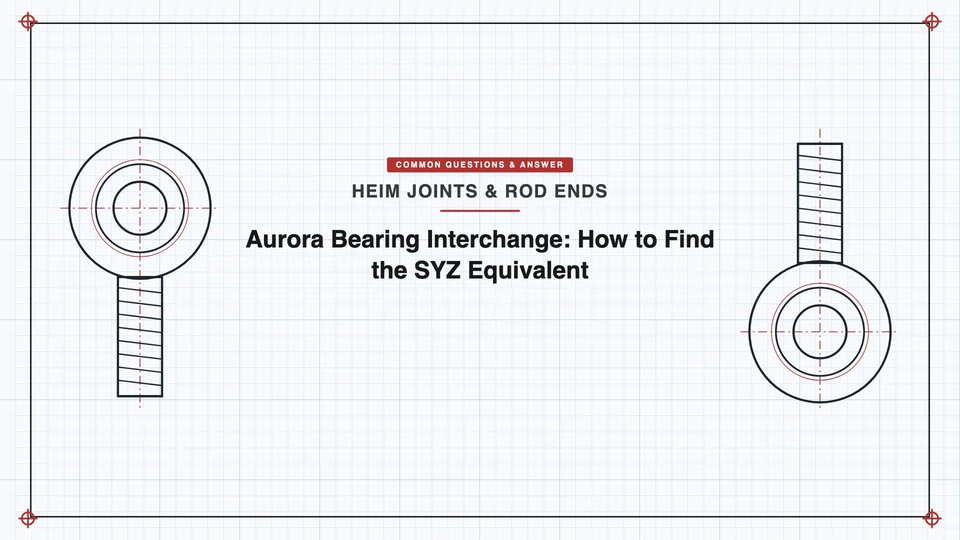
Matching an Aurora part number to an equivalent rod end starts with the full part number, not just the bore size — and it ends with checking actual dimensions, not just trusting a cross-reference table on its own.
Why Bore Size Alone Isn’t Enough
A complete Aurora part number (something like HAB-4TG or ANC-4TG) encodes more than bore diameter. Before treating any part as a true interchange, check:
- Bore diameter
- Housing outer diameter
- Bearing width
- Thread size and pitch
- Male vs. female thread
- PTFE-lined vs. metal-on-metal construction
- Staking groove, if the design uses one
- Material grade and load rating
Two parts can share the same nominal bore and still not be a real interchange if the outer diameter, width, liner type, or staking arrangement differs. Manufacturer interchange guidance is consistent on this point: use the part-number cross-reference as a starting point, then confirm against actual dimensions before specifying a replacement.
SYZ’s Actual Published Cross-References
SYZ Rod Ends’ own product documentation lists cross-reference relationships for several of its lines. As published on SYZ Rod Ends’ product pages:
| SYZ series | Construction | Cross-references |
|---|---|---|
| ALJM (male) / ALJF (female) / ALRSM (reinforced shank) | 3-piece aluminum, PTFE-liner option | FK, Aurora |
| JM(-T) / JF(-T) | Alloy steel, PTFE-lined option | FK, Aurora, QA1 |
| CM-M / CF-M | Carbon steel, PTFE-lined option | FK, Aurora, QA1 |
| EXM / EXF | Injection-molded reinforced nylon + PTFE | Aurora, QA1 |
These are the manufacturer’s own stated cross-reference groupings, not a third-party estimate — but "cross-referenced series" still means starting from the same design intent and general spec range, not an automatic drop-in guarantee for every size in that family. Confirm the specific dimensions against your Aurora part before ordering.
A Practical Process
- Start with the full Aurora part number, not just "quarter-inch bore" or a general description.
- Use the cross-reference table above to identify the likely SYZ series based on construction type (aluminum, alloy steel, carbon steel, or nylon/PTFE composite) and which brands that series is documented against.
- Pull the specific dimensions for both the Aurora part and the candidate SYZ part — bore, OD, width, thread, liner type, staking groove — and compare them side by side rather than assuming the series-level cross-reference settles it.
- If anything doesn’t match, treat it as a different part, not a close-enough substitute, especially for load-bearing steering or suspension applications where a dimensional mismatch affects fit or strength.
Related reading: FK Rod Ends vs. SYZ Machine: A Technical Performance Comparison · QA1 vs. SYZ: Understanding Materials and Value