
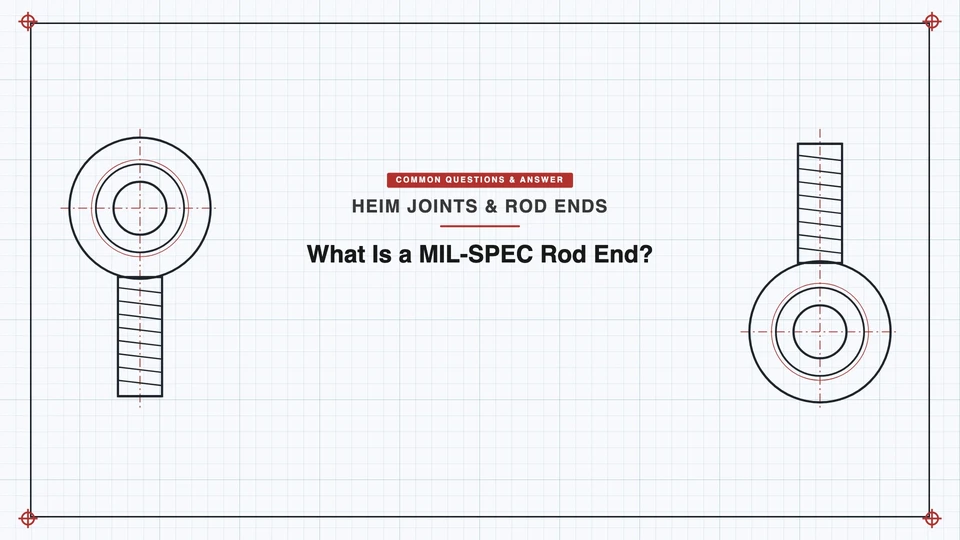
A MIL-SPEC rod end is a spherical rod-end bearing manufactured and accepted to a specific U.S. military specification — not simply a marketing label meaning "extra tough." The number after "MIL-B-" or "SAE-AS" identifies exact requirements for dimensions, materials, lubrication, load ratings, and finish. If you see "MIL-SPEC" on a listing without a specification number attached, you don’t actually know what you’re getting — the number is the part of the claim that’s checkable.
The Two Classic Specification Families
Most MIL-SPEC rod ends trace back to one of two original specifications, both since superseded by SAE aerospace standards but still referred to by their original military numbers in the field:
- MIL-B-81935 → SAE-AS81935. Self-aligning, self-lubricating, wide-body rod ends with a PTFE liner, rated for a -65°F to +325°F operating range. MIL-B-81935 was formally canceled on April 23, 1998, superseded by SAE-AS81935/1, per Defense Logistics Agency (DLA) records. This is the family most commonly seen in aircraft flight-control linkages and high-load steering applications where self-lubrication matters.
- MIL-B-6039 → SAE-AS6039. Double-row, self-aligning ball bearing rod ends, metal-to-metal construction, requiring grease lubrication rather than a PTFE liner. Inner rings and balls are typically through-hardened 52100 or 440C stainless.
Standard Part Numbers: What MS21150-Series Callouts Actually Mean
Alongside the detail specifications above, a family of military standard part numbers (MS21150, MS21151, MS21152, MS21153) covers double-row ball bearing rod ends distinguished by thread style and shank type — external thread, internal thread, solid shank, or hollow shank. These aren’t vague "mil-spec" catalog entries; each dash number carries a fully dimensioned spec sheet. An MS21153-3, for example, specifies: Class 3B threads, right-hand, shank diameter 0.365"–0.385", overall length 1.7455"–1.7855", bore diameter 0.1897" minimum, grease lubrication per MIL-G-81322, outer ring and rod end body material per MIL-S-6758, ball and inner ring material per MIL-S-7420, and cadmium plating per QQ-P-416 Type 1 Class 2. That’s the level of specificity "MIL-SPEC" is supposed to guarantee — a generic listing that just says "mil-spec rod end" without a dash number isn’t giving you any of this.
The Material and Process Chain Behind a MIL-SPEC Rod End
For the PTFE-lined family (the AS81935/MT-FT type), the material and process specification chain is fully documented by supplier technical data:
- Rod end body: 4340 alloy steel, heat treated per SAE-AMS-H-6875 (formerly MIL-H-6875), cadmium plated
- Outer race: 17-4PH stainless steel, heat treated per AMS5643
- Ball: 440C stainless steel, heat treated per AMS5630
- Liner: self-lubricating PTFE composite approved to SAE-AS81820 (formerly MIL-B-81820)
- Supporting process specs: anodizing per SAE-AMS-A-8625, magnetic particle inspection per ASTM-E-1444, penetrant inspection per ASTM-1417
A Distinction Worth Getting Right: AS81820 Is Not the Same Spec as AS81935
These two numbers get confused often enough that it’s worth stating plainly: SAE-AS81820 (formerly MIL-B-81820) governs the PTFE liner material itself — it’s a materials specification, one input into the finished part. SAE-AS81935 (formerly MIL-B-81935) governs the finished rod end — the complete product acceptance standard the assembled bearing has to meet. A rod end can correctly reference both numbers on its spec sheet at the same time, because one describes a component material and the other describes the assembled product. Treating them as interchangeable, or citing one when you mean the other, is a factual error that shows up more often than it should in casual technical writing on this topic.
Commercial Rod End vs. MIL-SPEC Rod End
| Feature | Commercial Grade | MIL-SPEC |
|---|---|---|
| Quality control | Lot sampling or minimal testing | Generally full or high-percentage inspection, often including NDT (magnetic particle/penetrant) |
| Liner bonding | Adhesive or mechanically pressed | Bonded PTFE liner to a documented, spec-controlled process with peel-strength requirements |
| Load ratings | Often estimated or based on static testing alone | Certified static and fatigue load capacity per the governing spec |
| Failure mode | Can bind or fail with less predictable warning | Designed toward a documented, more predictable wear/fatigue progression |
These distinctions describe how the two categories generally differ in practice, not a guarantee for every individual commercial-grade part — quality varies by manufacturer regardless of which category a part falls into. A well-made commercial rod end from a reputable manufacturer can meet or exceed a poorly-documented "mil-spec" listing from an unverified seller.
Why the Specification Number Matters More Than the Label
"MIL-SPEC" by itself tells you almost nothing checkable. The specification number — MIL-B-81935, SAE-AS6039, an MS21153 dash number — tells you exactly what materials, dimensions, load ratings, and inspection requirements the part is supposed to meet, and gives you something to verify against. If a listing or a supplier can’t provide that number, treat the "MIL-SPEC" claim as unverified until they can.
For how to confirm a specific rod end actually matches its claimed specification once you have a part in hand, see How to Spot Counterfeit or Refurbished Rod Ends. For how aerospace-grade documentation requirements compare to automotive-grade ones more broadly, see Aerospace Grade vs. Automotive Grade: What’s the Difference?
Related reading: Aerospace Grade vs. Automotive Grade: What’s the Difference? · How to Spot Counterfeit or Refurbished Rod Ends · Cross-Referencing OEM Part Numbers for Rod End Replacement