The housing: tensile and yield strength
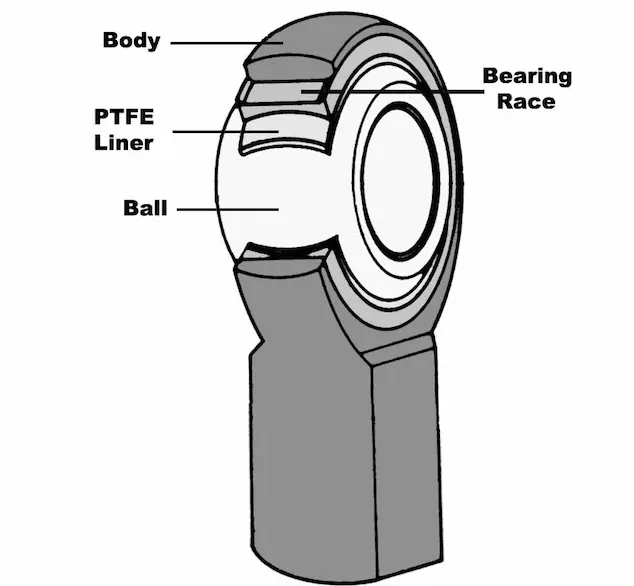
- Data: According to AISI (American Iron and Steel Institute) data, heat-treated 4130 steel offers a tensile strength of approximately 150,000 PSI.
- Failure prevention: Low-grade carbon steel housings are prone to “eye elongation,” where the hole stretches into an oval under high stress, causing immediate play in the suspension.
The ball and race: the wear surfaces
The ball is the only moving part and must be harder than the race to prevent galling.- Ball Material: Usually made from 52100 bearing steel, heat-treated and hard chrome plated.
- Surface Finish: High-precision balls are polished to a surface roughness (Ra) of less than 0.1 μm to minimize friction.
- The Race: In a 3-piece joint, the race acts as the cushion. It is typically made from bronze, brass, or stainless steel to provide a durable interface for the ball.
Related reading: What exactly is a Heim joint? · 2-piece vs. 3-piece rod ends: which design is better? · What is a “self-lubricating” rod end?