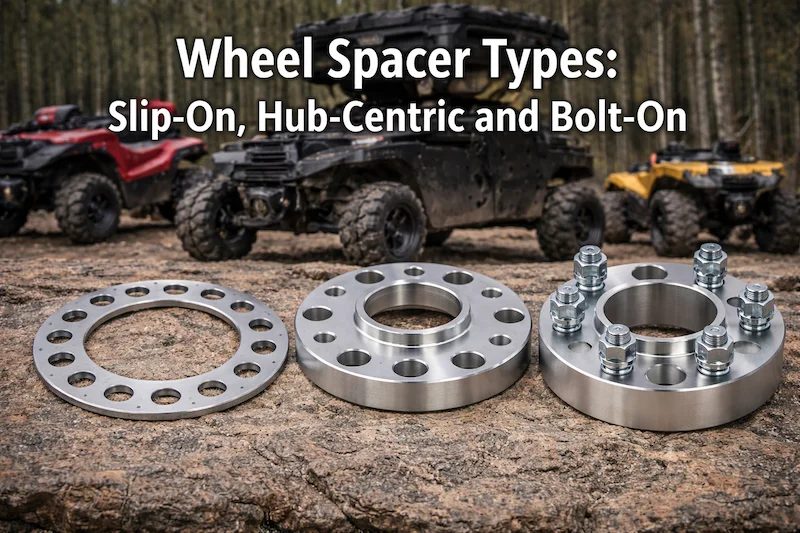
If you’re new to wheel spacers, the terms Bolt-On, Slip-On, and Hub-Centric can feel like alphabet soup. But here’s the key: Bolt-On and Slip-On describe how you install the spacer. Hub-Centric describes how it centers on the hub. They’re different dimensions of the same product—Hub-Centric can be either Bolt-On or Slip-On.
Get that relationship straight, and choosing becomes way easier.
Slip-On: Quick and Simple
Slip-On spacers are as straightforward as it gets: slide them onto the hub, then use your wheel’s existing bolts to secure the wheel on top. Installation’s basically like changing a tire—no special tools, maybe ten minutes per corner.
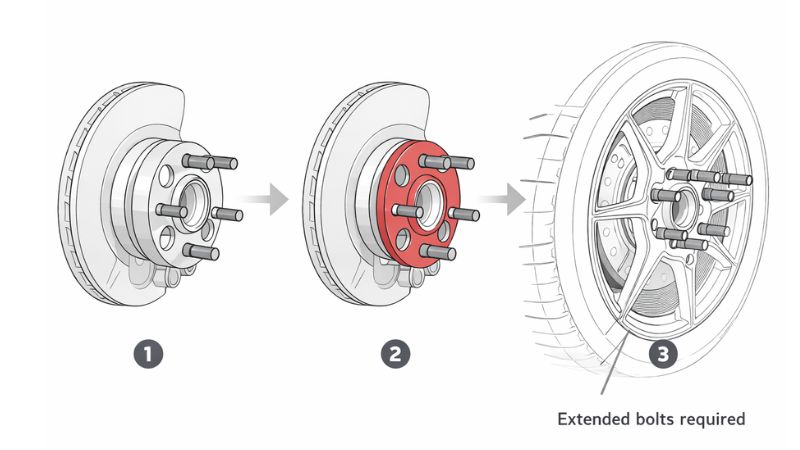
The advantages of this method are obvious: installation and removal are quick, suitable for scenarios requiring flexible adjustment or occasional removal.
However, Slip-On has a key thickness limitation: generally not exceeding 15mm. The reason is that after the spacer adds thickness, OEM bolts are often not long enough to ensure sufficient thread engagement—industry standards generally require at least 6-7 turns of thread engagement. If installing Slip-On spacers over 5mm, you must also replace with extended studs, otherwise safety risks are significant.
Warning: Another easily overlooked issue is Hub Lip Depth. OEM hub lips are typically only 10-12mm long, so if you install an 8-10mm Slip-On spacer, the exposed portion of the lip may be insufficient to achieve Hub-Centric centering. In this case, you must choose specially designed spacers with lip extension features.
Bolt-On: Better for Large Thickness and High Reliability Scenarios
Bolt-On spacers’ installation logic is exactly opposite to Slip-On: first secure the spacer to the hub with bolts, then use the spacer’s own built-in studs to secure the wheel to the spacer. In other words, there are two independent layers of bolt connections between the spacer and wheel.
The core advantage of this design is: spacers come with their own studs, so thickness isn’t constrained by OEM stud length—common thicknesses range from 15mm to 50mm. The two-layer fastening structure also significantly improves overall connection robustness. According to recommendations from professional wheel accessory guides, in scenarios demanding high reliability like off-road and racing modifications, Bolt-On is the more popular solution within the industry.
Safety Key Point: When installing Bolt-On spacers, the nuts securing the spacer to the flange absolutely cannot protrude beyond the spacer surface. If they protrude, the wheel back will be blocked, causing load concentration at a few points, creating fracture risk during high-speed driving.
However, the tradeoff is slightly more complex installation, and removal isn’t as casual—especially in situations requiring quick tire changes in the field, Slip-On is more convenient.
Hub-Centric: Centering Precision Is Key
As mentioned earlier, Hub-Centric isn’t a third independent installation type, but rather a centering method—it can run through both Bolt-On and Slip-On installation methods.
The core design of Hub-Centric spacers is: the center bore diameter precisely matches the hub’s centering lip, typically called the Hub-Centric Lip (centering ring). This precise matching means the vehicle’s weight is mainly transferred to the hub through the center bore, with bolts only responsible for fastening and not needing to bear the main load. In contrast, non-Hub-Centric (Lug-Centric) spacers have oversized center bores, relying on the bolts themselves for centering—easily producing slight vibration during high-speed driving or cornering.
From practical use perspective, Hub-Centric is markedly better for high-speed stability and long-term wheel bearing life protection. Currently, spacers for professional modification and racing applications are almost entirely Hub-Centric designs, and this trend has become increasingly evident in recent years.
Materials and Bolts
After choosing type and installation method, material and bolt selection are equally important—they directly determine whether spacers can withstand your use case.
Aluminum alloy materials are the mainstream choice for wheel spacers—lightweight and corrosion-resistant, suitable for the vast majority of modification scenarios. Process is more important than material grade: you must choose Forged or Billet (CNC machined from solid aluminum billet) products. Cheap Cast aluminum materials on the market, even with high grade labels, easily have internal porosity and have far less toughness than solid machined products.
Regarding specific alloy grade differences:
- 6061-T6 Aluminum Alloy: Yield strength approximately 276MPa, good corrosion resistance, stable machining. Suitable for daily driving and general off-road scenarios. Best cost-performance ratio, largest market share.
- 7075-T6 Aluminum Alloy: Yield strength approximately 503MPa, about 80% stronger than 6061-T6. Suitable for racing grade or high-load conditions. Higher price but also greater strength margin.
Surface treatment is equally critical: quality spacers undergo Anodizing treatment, which isn’t just for aesthetics but more importantly prevents Galvanic Corrosion between aluminum alloy and steel flanges, otherwise over time components will “weld” together and won’t come off.
Bolts are equally important. Wheel spacer bolts bear significant force, generally recommending Grade 10.9 or 12.9 high-strength bolts. If using Slip-On method requiring extended stud replacement, recommend choosing ARP brand high-strength extended studs—in the modification community, ARP’s reputation and reliability in the bolt field are industry-leading.
Choose Based on Your Needs
Putting all the above information together, choosing is actually very straightforward:
Daily Aesthetics or Light Off-Road: Slip-On + Hub-Centric + 6061-T6, thickness 5-10mm. Simple installation, obvious effect, easy maintenance.
Off-Road Modification or Track Use: Bolt-On + Hub-Centric + 7075-T6, thickness 15-25mm. Higher safety, more flexible thickness.
Need to Modify Bolt Pattern (PCD): This situation requires the adapter version of Bolt-On—one end matches the hub’s bolt pattern, the other end matches the target wheel’s bolt pattern. This application demands extremely high machining precision and must choose Vehicle-Specific products from professional manufacturers, can’t cheap out on universal models.
Final Step: Precisely Match Your Vehicle
After choosing type, material, and bolts, the final step is ensuring dimensions precisely match—center bore diameter (Center Bore), bolt pattern (PCD), and thread specifications must all align with your vehicle.
SYZ Machine as a professional wheel spacer supplier, uses full CNC precision machining, covering custom specification needs for various vehicle models. Whether standard models or adapters, every part’s tolerances are strictly executed according to mechanical machining standards, ensuring what’s installed is precisely matched.