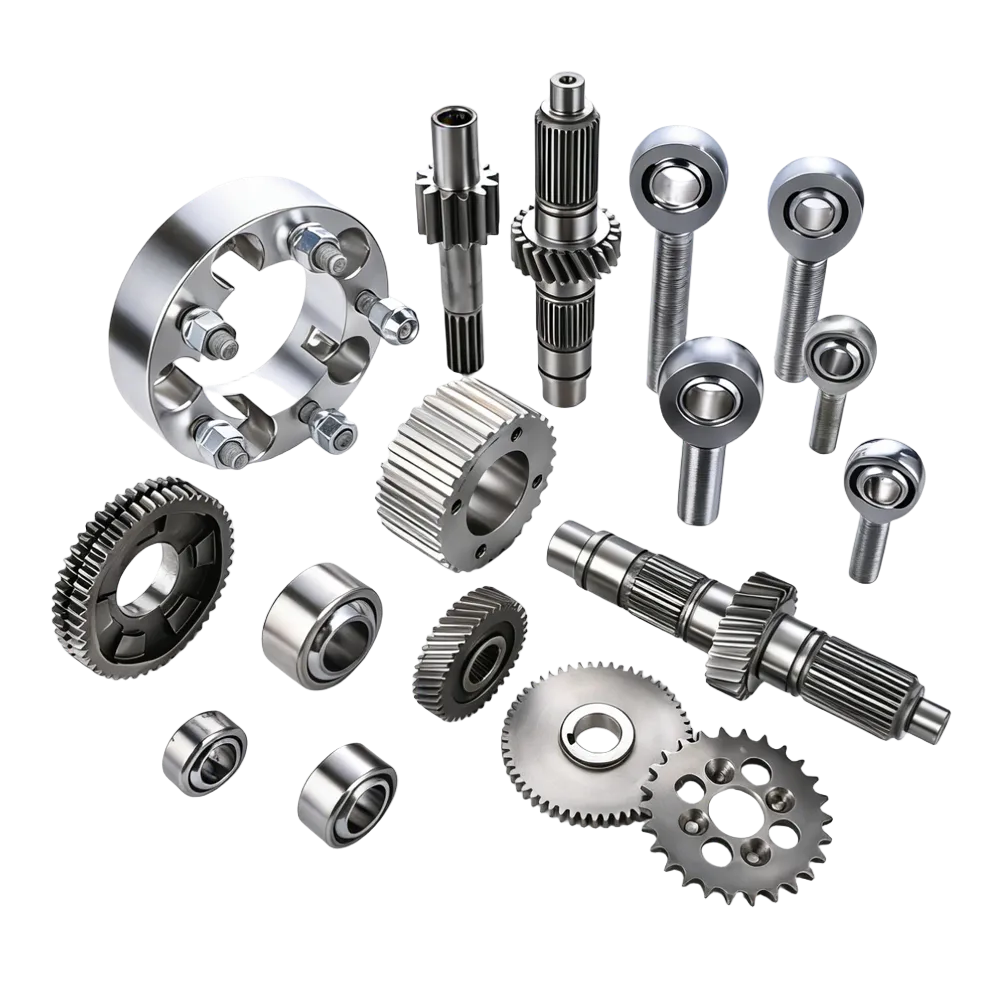

Most bushings fall into two recognizable shapes: a thick rubber or polyurethane ring with a metal sleeve through the center (automotive/suspension bushings), or a simple hollow metal or plastic cylinder (industrial/mechanical bushings). What they have in common is the basic form — a cylinder designed to fit into a hole or around a shaft.
Automotive Suspension Bushings
These are the type most people picture: a thick rubber or polyurethane cylinder bonded around an inner metal sleeve, with a bolt passing through the sleeve to mount it to the vehicle. Many also have an outer metal shell that presses into the control arm, sway bar bracket, or subframe mount. Color is a useful visual clue — black rubber is the typical factory material, while bright colors (red, blue, yellow) usually indicate an aftermarket polyurethane replacement.
Industrial and Mechanical Bushings
Away from suspension applications, bushings tend to be simpler in shape: a straight hollow cylinder, most often bronze, brass, steel, or a low-friction plastic like nylon or PTFE. Two basic forms cover most of what you’ll see:
- Straight (plain) bushings — a simple tube, pressed into a bore.
- Flanged bushings — the same tube with a flat rim (“flange”) at one end, which helps the bushing carry side-to-side (thrust) loads in addition to radial ones.
Some are ridged, grooved, or fitted with small graphite plugs on the inner surface — these are lubrication features, not defects, designed to hold oil or graphite at the sliding contact surface.
New vs. Worn: What to Look For
If you’re trying to visually inspect a bushing rather than just identify one, the difference between healthy and failing is usually easy to spot:
| Condition | What it looks like |
|---|---|
| New / healthy | Rubber or polyurethane surface is smooth, firm, and fully bonded to the metal sleeve with no visible gaps |
| Worn / failing | Cracked, dry-rotted, or bulging rubber; visible separation or tearing between the rubber and the metal sleeve; the rubber squished flat or off-center |
That visible separation between rubber and metal is usually the clearest sign — a bushing doesn’t need to be fully torn apart to be worn out, but a gap where the rubber has pulled away from the metal it’s bonded to is a reliable visual indicator that it’s no longer doing its job.
Other Forms You Might Encounter
The word “bushing” also describes parts outside the automotive/industrial scope covered here — skateboard trucks use small cone- or donut-shaped polyurethane bushings, and electrical work uses insulated bushings that are a different object entirely (see What Is a “Bond Bushing”? for that distinction). If none of the shapes above match what you’re looking at, it may be worth checking which category applies to your application.
Related reading: What Is a Bushing? Definition, Materials, and How It Works · How Do Bushings Work? · Types of Automotive Bushings by Mounting Location