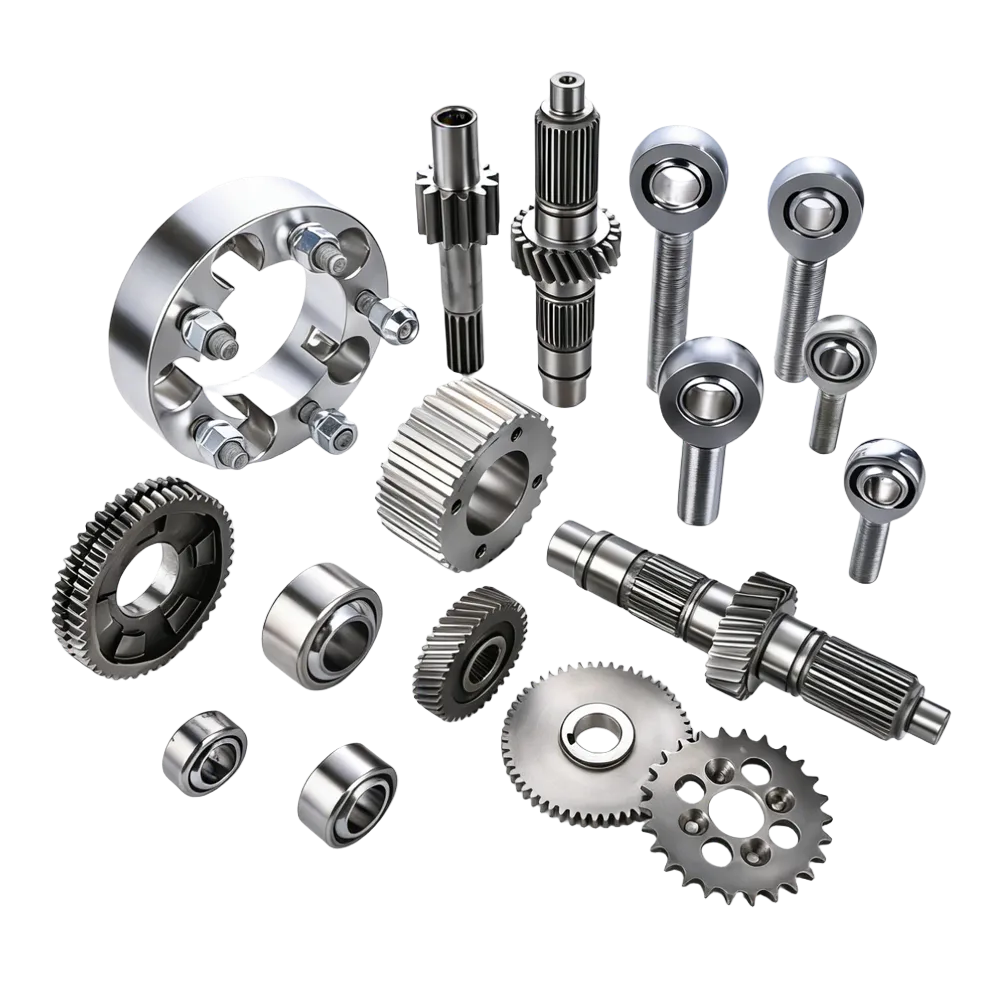
A universal joint and a carrier bearing are both driveline parts, but they do completely different jobs. A U-joint lets a rotating shaft bend through an angle while still transmitting torque — it sits at each end of the driveshaft. A carrier bearing supports and stabilizes a long driveshaft — it sits at the midpoint, on a two-piece design. For the full definition of either part on its own, see What Is a Universal Joint? and What Is a Carrier Bearing?. This article covers what neither of those does on its own: the types each part comes in, and a direct side-by-side of what each one actually does.
Four Types of U-Joint
| Type | How it works | Where it’s used |
|---|---|---|
| Cross and roller (needle bearing) | Standard cross/spider with needle-bearing caps at each arm | Most common automotive design — high torque capacity, durable at typical operating speeds |
| Plain bearing (friction) | Bushings/sliding surfaces instead of needle bearings | Simpler, lower cost; more friction and less efficient at higher speed |
| Double Cardan | Two U-joints paired back-to-back in one compact assembly | Cancels the single-joint speed variation internally; common on 4WD front driveshafts and steeper operating angles |
| Constant velocity (CV) joint | Different internal geometry — maintains genuinely constant output speed | Front-wheel-drive axles and independent suspensions, where the joint has to handle a larger operating angle |
Three Types of Carrier Bearing
| Type | Design | Typical use |
|---|---|---|
| Single carrier bearing | One bearing supporting the midpoint of a two-piece driveshaft | Pickups, vans, and other long-wheelbase two-piece-driveshaft vehicles |
| Rubber-isolated center support bearing | Bearing set in a rubber isolation mount | The most common passenger-vehicle design — the rubber absorbs vibration before it reaches the frame |
| Heavy-duty carrier bearing | Reinforced bearing and mount rated for higher load | Commercial vehicles and higher-torque applications |
The Part That Actually Answers “Which One Do I Need to Worry About”
| Part | Core job | Where it’s mounted |
|---|---|---|
| Universal joint (U-joint) | Lets the shaft bend through an angle while still transmitting torque | Both ends of the driveshaft |
| Carrier bearing | Supports and stabilizes the shaft | Midpoint of a two-piece driveshaft |
The two parts routinely work together on the same vehicle — a two-piece driveshaft typically has a U-joint at each end plus a carrier bearing supporting the middle — but they’re not interchangeable and one can’t substitute for the other’s job. If a shaft is vibrating or clunking, which of these two you’re actually dealing with depends on where the symptom is coming from, not on which part happens to be more familiar.
Related reading: What Is a Universal Joint? · What Is a Carrier Bearing? · How to Change a Carrier Bearing