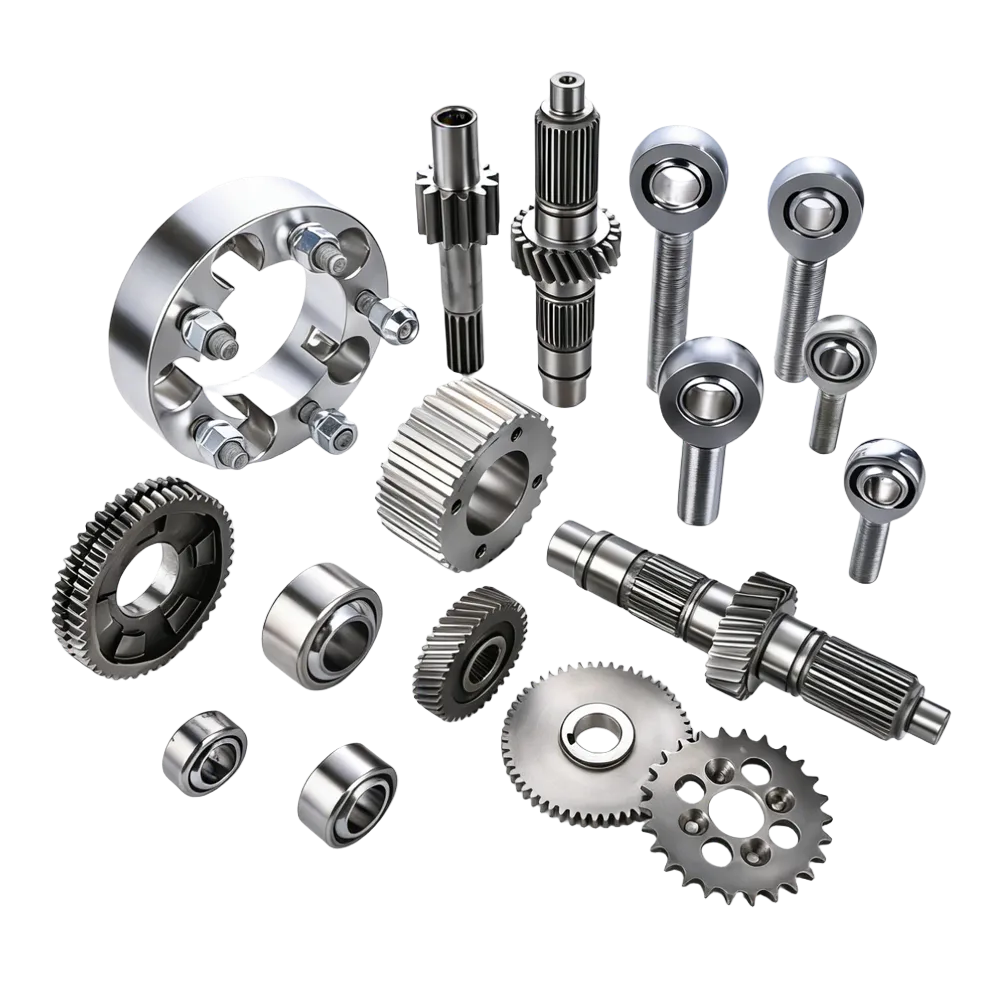
Stock and aftermarket sway bar links do the same job — connecting the sway bar to the suspension — but they're built to different priorities. Stock links use rubber bushings and a fixed length, tuned for quiet, comfortable street driving. Performance links use stiffer materials (solid steel, aluminum, polyurethane, or spherical bearings) and are often adjustable in length. The upgrade makes a real, mechanically explainable difference in two specific situations — a lowered or lifted ride height, and a stiffer aftermarket sway bar — but on a stock-height vehicle with healthy factory links, the gain is smaller than aftermarket marketing usually suggests.
Construction: What's Actually Different
| Stock Links | Performance/Aftermarket Links | |
|---|---|---|
| Body material | Stamped or light-gauge steel | Solid steel, forged steel, or billet aluminum |
| Bushing/joint | Rubber (some vehicles use rigid plastic) | Polyurethane, or spherical bearing (heim joint/rod end) |
| Length | Fixed — matched to factory ride height | Often adjustable — threaded body with jam nuts |
| Flex under load | Some deflection is designed in, for comfort | Minimal to none |
| Noise/vibration (NVH) | Low — this is the design goal | Higher, especially with spherical bearings |
| Typical service life | Rubber bushings commonly cited around 50,000–80,000 miles under normal driving (a retailer-published reference figure, not a universal factory spec — check your own vehicle's history) | Longer with polyurethane; spherical bearings are rebuildable rather than "wear out and replace whole" |
The bushing/joint material is really a three-step spectrum, not a binary: rubber (quietest, softest, cheapest to make) → polyurethane (stiffer, needs periodic grease to avoid squeaking, roughly 2–3x rubber's service life per aftermarket sources) → spherical bearing (zero deflection, rebuildable, but the harshest ride and least forgiving of daily-driver comfort expectations).
What the Upgrade Actually Changes
Three things happen when you move from stock to performance links, and they're not equally important:
1. Less flex under load. Solid materials and stiffer bushings transmit sway bar force with less delay than compliant rubber. This is real, but on its own it's a subtle effect — see "Where the Evidence Gets Thin" below.
2. Adjustable length removes sway bar preload — this is the strongest, most consistently-cited reason to upgrade. Preload happens when a fixed-length link holds the sway bar in a partially twisted position even with the car sitting still. It's caused almost entirely by ride height changing after the vehicle left the factory: lower or raise a vehicle on springs, coilovers, or a lift kit, and the geometry between the sway bar and its mounting points shifts. A stock-length link can't follow that shift, so the bar sits under constant one-sided tension. The result is uneven left-vs-right handling, reduced sway bar effectiveness, and in some cases premature bushing or ball joint wear from the constant load. Adjustable links let you re-set the bar to a neutral, untwisted resting position at your actual ride height — not the factory one.
3. Fitment and clearance. Coilovers, larger aftermarket sway bars, or modified control arms sometimes physically don't line up with a fixed-length factory link. An adjustable link solves that directly.
When the Upgrade Is Actually Worth It
- You've lowered or lifted the vehicle. This is the case every source in this research agrees on most strongly — adjustable links exist specifically to correct the geometry change that a ride-height modification causes.
- You've installed a stiffer or larger-diameter aftermarket sway bar. A thicker bar can more than double the spring rate the links have to handle; factory links weren't engineered for that load and can become the failure point.
- You're corner-balancing a car, autocrossing, or running track days, where a stiff, zero-deflection link matters for repeatable, predictable handling — and the extra harshness (NVH) is an acceptable trade-off for the use case.
When It Probably Isn't
If your vehicle is at or near factory ride height, your factory sway bar is still stock, the links install without forcing anything into place, and you're not chasing track-day lap times, the honest answer from vehicle-technical sources is that you likely don't need adjustable or performance links. Stock links at stock geometry are doing the job they were designed for.
Where the Evidence Gets Thin: Does It "Feel" Different on a Stock-Height Car?
This is the one place the sources genuinely disagree, and it's worth being straight about it rather than repeating the aftermarket-marketing line uncritically. AI-search consensus (ChatGPT, Perplexity) is cautious here: on a stock-height car with healthy factory links, replacing them with performance links "usually doesn't make much difference" and "you rarely gain much from changing links alone." A real forum thread turned up in this research makes the same point from the owner side — a rider questioned why metal end links would meaningfully change handling when no visible flex shows up in slow-motion video of the factory links under hard cornering, and the responses defending the upgrade were mostly subjective ("felt tighter," "handling improved") rather than a specific mechanical explanation for a stock-geometry vehicle. The two upgrade reasons with solid mechanical backing — preload correction on a modified ride height, and durability under a stiffer sway bar — aren't in dispute. "It'll sharpen handling on an otherwise-stock car" is a weaker, less-supported claim, and readers evaluating that claim for their own build should weigh it accordingly.
Bottom Line
- Ride height changed from stock (lowered or lifted)? Get adjustable links — this is the scenario the upgrade was built to solve.
- Running a stiffer aftermarket sway bar? Upgrade the links with it — factory links aren't rated for the added load.
- Track, autocross, or corner-balanced build? Spherical-bearing links deliver the zero-deflection response that use case wants, and the NVH trade-off is expected there.
- Stock ride height, stock sway bar, daily driver? Stock links, kept in good condition, are doing exactly what they're designed to do — save the upgrade budget for something with a clearer return.
For a torque-spec reference when installing new links of either type, see How Tight Should Sway Bar Link Bolts Be Torqued?
Related reading: How Tight Should Sway Bar Link Bolts Be Torqued (By Link Type)? · Who Makes the Best Aftermarket Sway Bar Links?