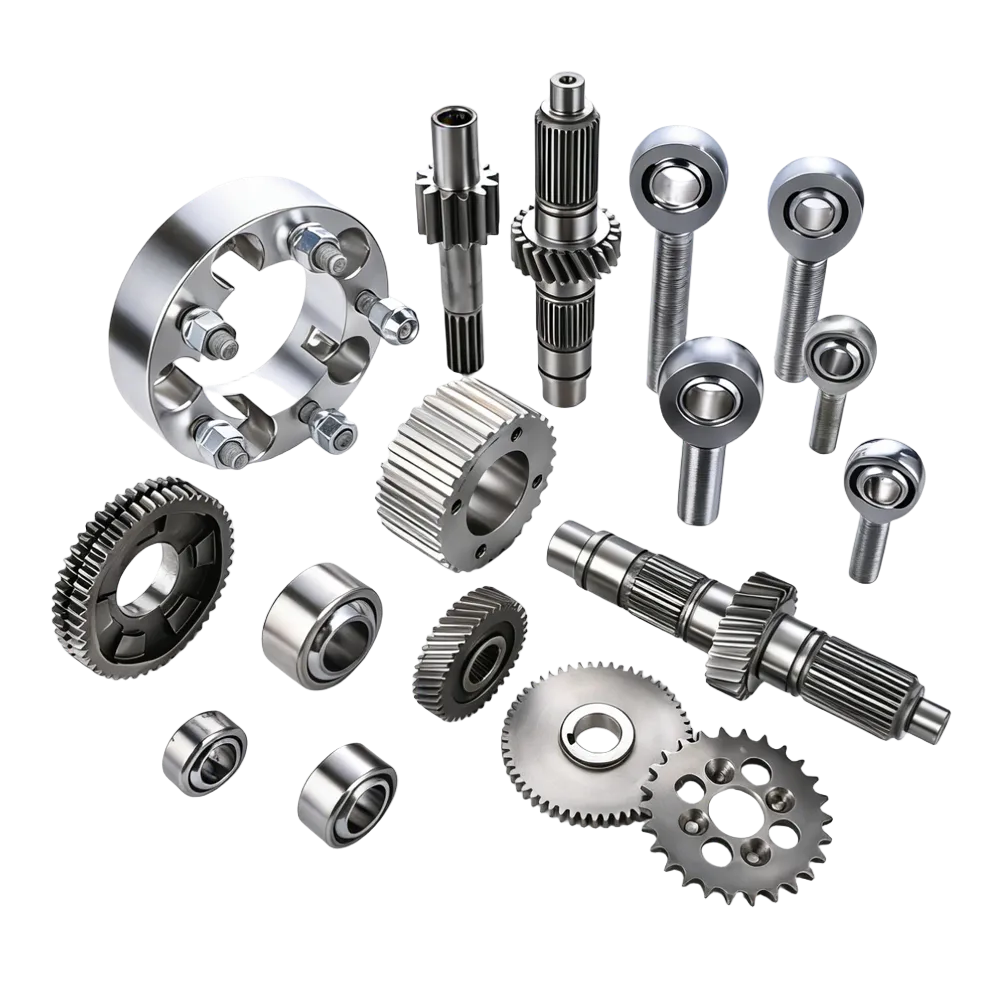

Yes — a wheel spacer can get you a flush stance using the wheels you already own, because it does the same thing a lower-offset wheel does: it pushes the wheel and tire assembly farther out from the hub. A 15 mm spacer on a wheel with a factory offset of ET45 gives you the same outward position as a wheel built with roughly ET30. But "can" isn't the same question as "should" — and the honest answer depends on how far out you need to go and how much engineering risk you're willing to accept to get there.
The Math: Spacer Thickness = Offset Reduction
Offset (ET, from the German Einpresstiefe) is the distance between the wheel's true centerline and its mounting face. A higher positive number tucks the wheel inward, toward the suspension; a lower number — or a negative one — pushes it outward, toward the fender.
A spacer sits between the hub and the wheel and moves the entire assembly outward by exactly its thickness. That's a direct, 1:1 subtraction from effective offset:
| Original wheel offset | Spacer thickness | Effective offset (visual result) |
|---|---|---|
| ET45 | 10 mm | ~ET35 |
| ET45 | 15 mm | ~ET30 |
| ET45 | 20 mm | ~ET25 |
| ET40 | 25 mm | ~ET15 |
These are illustrative examples, not universal specs — your actual flush point depends on your specific fender line, tire width, and ride height, and should be measured on the car, not assumed from a table. As a rough industry reference point, enthusiast fitment guides commonly cite 10–20 mm lower than OEM offset as the range where a "flush" look shows up on most platforms, with a more conservative 5–12 mm range sometimes called "functional flush" — aggressive enough to fill the fender gap without requiring fender rolling or a stretched tire. Treat both ranges as community-sourced starting points to verify against your own vehicle, not a spec you can order to.
The Real Comparison: Spacer vs. New Offset Wheels
Both approaches move the wheel outward. The difference isn't in what they do — it's in how they do it, and what that difference costs you in reliability, money, and flexibility.
| Factor | Wheel Spacer | New Offset Wheels |
|---|---|---|
| Mechanical integration | Adds a mechanical joint between hub and wheel — one more mating surface, one more set of fasteners to torque and re-check | Offset is built into the wheel casting/forging — no added joint, fewer failure points |
| Suspension & bearing load | Identical to an offset wheel at the same outward distance — moving the contact patch out by 25 mm loads the bearing the same whether that 25 mm comes from a spacer or from the wheel's own design | Identical — this is not a spacer-specific downside, it's a physics consequence of any track-width increase |
| Typical cost | Roughly $100–300 for a set of four, depending on thickness and material (market reference pricing, not a SYZ quote) | Roughly $100–400 per wheel before tires, mounting, balancing, and TPMS sensor transfer — the full-set cost adds up fast |
| Clearance range solved | Inner clearance only — rubbing against struts, control arms, brake calipers | Full package — width, diameter, and offset can all change together, solving inner and outer clearance in one part |
| Reversibility | Fully reversible — remove the spacer, you're back to stock | Reversible in theory, but you've already spent the money; going back means eating the cost twice |
| Best suited for | Minor-to-moderate fitment correction on wheels you already like | Major stance changes, track/tow use, or any case where the outward distance needed exceeds a safe spacer thickness |
The suspension-and-bearing-load row is the one most people get backwards. There's a common assumption that spacers are inherently harder on bearings than "just running the right offset wheel" — they're not. The load a wheel bearing sees is a function of how far outward the tire's contact patch sits relative to the hub, full stop. A spacer and a negative-offset wheel that produce the same track-width increase produce the same bearing leverage. The real variable is execution: a cheap, non-hub-centric spacer that relies on the studs alone for centering adds real risk beyond the geometry change; a properly fitted, hub-centric spacer installed with correct thread engagement does not add meaningful risk beyond what the offset change itself already costs you. (SYZ Machine's Wheel Spacers: Pros and Cons covers the bearing-wear and steering-feel trade-offs in full — this article doesn't repeat that analysis, just flags that it applies here too.)
When to Reach for a Spacer, and When to Buy the Wheel
Use this order of operations rather than picking based on preference alone:
- Figure out the effective offset you actually need. Measure the current gap between tire and fender edge, and work out roughly how many millimeters of outward movement closes it (see the table above for the arithmetic).
- Check whether that thickness falls inside a safe spacer range for your platform. Most hub-centric spacer systems are engineered up to roughly 20–25 mm before thread engagement, fender clearance, and bearing load start becoming the limiting factor rather than the spacer itself — this threshold is platform- and product-specific, not a fixed number, so confirm it against the spacer manufacturer's rated range for your vehicle rather than assuming a round number applies universally.
- If the number you need is inside that range, and you like your current wheels: a spacer is the lower-cost, reversible path. This is the case where the "vs. buying new wheels" comparison clearly favors the spacer.
- If the number you need exceeds a safe spacer thickness, or you also want a different width/diameter/tire package: stop adding spacer thickness and start pricing new offset wheels instead. Stacking an oversized spacer to reach a stance that really calls for a redesigned wheel is where the mechanical-integration downside in the table above stops being theoretical.
What Doesn't Change Either Way
Whichever path you choose, the fitment fundamentals don't go away: the spacer or wheel still has to match your vehicle's bolt pattern and be properly centered on the hub (hub-centric, not relying on lug studs alone to locate the wheel), and any thickness beyond a few millimeters typically requires extended studs or bolts to keep full thread engagement. Skipping either of those isn't a stance shortcut — it's the actual point of failure in most spacer horror stories, regardless of which fitment path got you there.
Related reading: Wheel Spacers: Pros and Cons · Why Do You Need Wheel Spacers? · Wheel Spacer Types: Bolt-On, Slip-On, and Hub-Centric