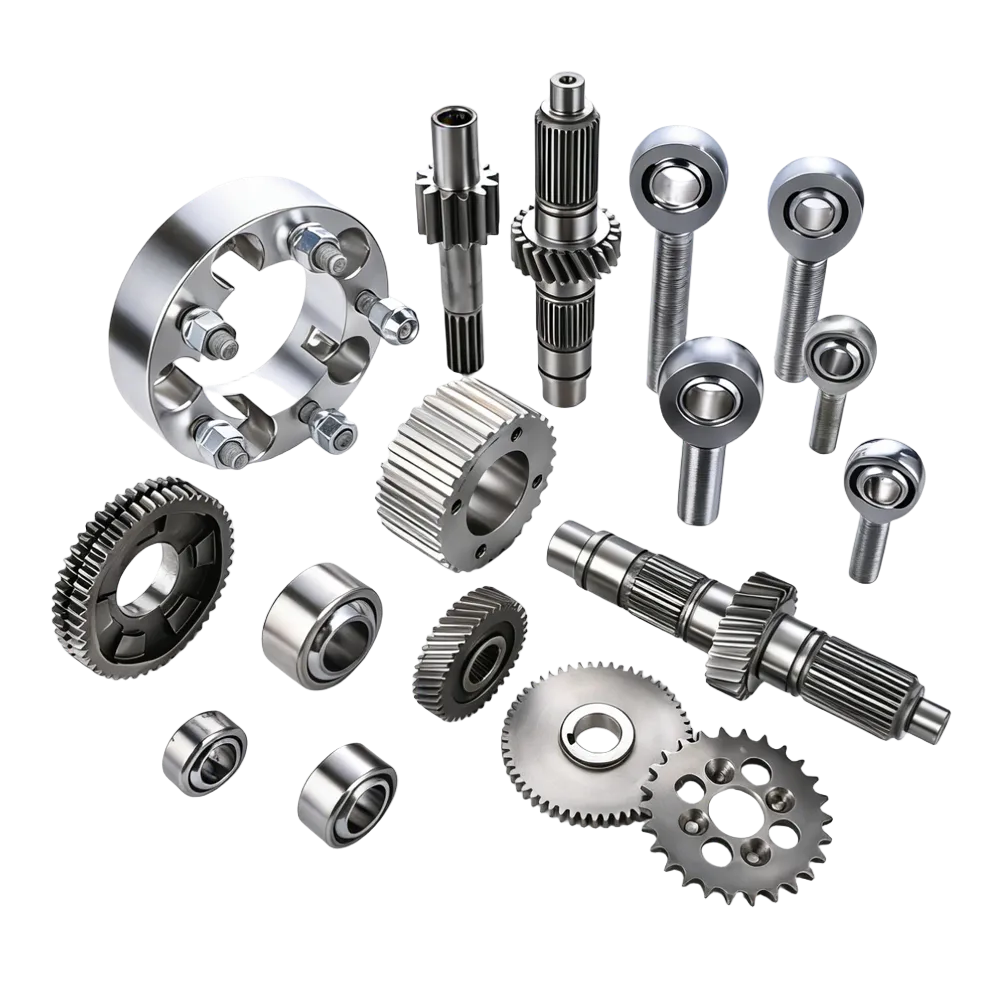

Yes, for a single high-quality, correctly installed spacer — including up to 2 inches on a 4×4 truck. No, for stacking two spacers, at any thickness, ever. Everything else about wheel spacer safety comes down to those two facts plus how much leverage the specific thickness adds to your bearings, ball joints, and steering components.
The Short Version, by Thickness
| Thickness | Type | Safety verdict | Main thing to check |
|---|---|---|---|
| 1/4" (~6mm) | Slip-on | Least risk of the three | Thread engagement — a thin spacer eats into how far the lug nut can thread onto the stud |
| 1.5" (38mm) | Bolt-on | The common "sweet spot" for trucks | Must be bolt-on with its own studs, not a slip-on plate |
| 2" (50mm) | Bolt-on only | Structurally OK with quality parts; biggest wear trade-off | Bearing/steering load, fender clearance, hub-centric fit |
| Two spacers stacked | Either | Not safe at any combination | There isn't a safe combination — see below |
1/4-Inch: Check Thread Engagement, Not Just the Spacer
A 1/4" spacer is thin enough that it's usually a slip-on design — it slides over your existing wheel studs, and your factory lug nuts thread down over the spacer to grab the wheel. The spacer itself isn't the risk here; what actually fails on thin slip-on spacers is running out of thread before the lug nut is fully seated.
The rule of thumb (confirmed across multiple sources): you need lug nut engagement roughly equal to the stud's diameter, or about 6–8 full turns. One retailer's published minimum-engagement chart gives concrete numbers by thread size:
| Stud thread | Minimum engagement |
|---|---|
| M14×2.0 | 7mm |
| M14×1.5 | 9.5mm |
| M14×1.25 | 11mm |
| M12×1.75 | 7mm |
| M12×1.5 | 8mm |
| M12×1.25 | 9.5mm |
| 1/2"-20 | 10mm |
| 5/16"-18 | 6mm |
| 7/16"-20 | 8.5mm |
| 9/16"-18 | 10mm |
If your spacer thickness plus lug nut length doesn't clear that minimum, you need longer studs — not a thinner spacer, and not "close enough." A lug nut that looks tight but isn't fully engaged is a slow-motion version of the same failure a stacked spacer produces faster: not enough thread holding the wheel on.
1.5-Inch: Why It's the Common Recommendation for Trucks
At 1.5", a slip-on design isn't really an option anymore — the spacer needs to be bolt-on, meaning it bolts to your factory hub with its own hardware, then carries its own set of studs for the wheel to mount to. That second, independent set of studs is why 1.5" gets recommended so consistently: you're not depending on stretched factory stud length to hold the wheel, you have full thread engagement on both connections.
The trade-off starts here too. Moving the wheel 1.5" further from the hub increases the leverage ("moment arm") that bearings, ball joints, tie rods, and axle components have to resist every time you brake, corner, or hit a bump. On a well-maintained truck with quality parts, that's a manageable trade-off. On a truck with marginal wheel bearings or worn suspension components already, it's added stress on components that were already close to the edge.
2-Inch: Structurally Fine, Mechanically the Biggest Ask
Two inches is where "can this fail" and "how much will this wear out my truck faster" become two separate questions with two separate answers. Structurally, a properly engineered, forged, bolt-on hub-centric 2" spacer from a reputable manufacturer rarely shears or snaps on its own. What it does reliably do is create a large lever arm similar to running wheels with a very aggressive negative offset — every load path through the wheel bearing, ball joints, and tie rods now has roughly twice the leverage of the 1" case.
Expect that leverage to show up as:
- Faster wear on wheel bearings, especially with heavy tires, towing, or hard off-road use
- Increased load on ball joints and tie-rod ends
- A larger scrub radius change, meaning heavier steering effort and more kickback over bumps
- Reduced clearance to fenders and wheel wells — a 2" spacer per side adds roughly 4" to overall track width, which is enough that tires can contact fenders or liners during suspension compression or full steering lock on some trucks
None of this makes 2" spacers unsafe by design. It means the margin for error — quality of the spacer, correct hub-centric fit, correct torque, condition of the rest of the front end — matters more at 2" than it does at 1/4".
4×4 Trucks Specifically: The Load Factors That Stack Up
A stock daily-driven pickup and a built 4×4 running 35"+ tires, heavy off-road wheels, and towing regularly are not the same load case, even with an identical spacer. The factors that raise the stakes on a 4×4:
- Larger, heavier tires — more rotating mass and a bigger contact patch load bearings and studs harder than the factory tire the spacer thickness was originally rated around
- Frequent off-road impacts — potholes and washboard are steady-state stress; rocks, ruts, and whoops are shock loads, and shock loads are what actually break marginal hardware
- Towing — adds static and dynamic load on top of everything else at exactly the moment the spacer's leverage is working against the bearing
- Diesel trucks — generally heavier curb weight than an equivalent gas truck, which raises the baseline load before the spacer's leverage effect is even factored in
We haven't found a published failure-rate or bearing-life statistic specific to spacer-plus-4×4-load combinations — the sources above describe these as qualitative risk factors, not measured outcomes, and that's how we're presenting them here. The practical takeaway: a 4×4 running several of these factors at once is a case for staying on the thinner end of what actually solves your clearance problem, and for being more conservative about spacer quality, not less.
Stacking Two Spacers: Never, at Any Combination
This is the one part of wheel spacer safety with zero disagreement across every source we found — automotive experts, spacer manufacturers, and mechanics all say the same thing: don't stack spacers. Not two thin ones, not a thin one on a thick one, not "just this once to get the exact offset I need."
Why stacking fails mechanically, not just "as a rule":
- Hub-centric support disappears. A quality spacer is hub-centric — its center bore sits precisely on your hub's centering lip, so the vehicle's weight rests on the hub flange, not on the studs. Stack a second spacer on top and the wheel is no longer riding on that hub lip at all; the entire vehicle weight shifts onto the studs in shear, which is a load path studs aren't designed to carry long-term.
- Every added mating surface is a place to lose clamping force. Two spacers means two extra flat-on-flat contact surfaces beyond the original hub-to-wheel joint. Any imperfection, debris, or thermal expansion difference between those surfaces creates a gap that lets clamping force relax over time — and once it relaxes, lug nuts back out faster than a single-spacer setup would.
- Leverage compounds. A 1/4" spacer stacked on a 1.5" spacer isn't a 1.75" spacer mechanically — it's two separate leverage arms and two separate joints, each adding its own flex and vibration on top of the other.
There is no thickness where this becomes safe — even two thin 3–5mm spacers stacked together carry the same structural problem as stacking two thick ones. If you need a specific total thickness, buy a single spacer machined to that thickness. It costs more than doubling up spare parts you already own, and that's the point.
Non-Negotiable Safety Checklist
However thick the spacer you're running, these apply across the board — we won't re-argue the mechanics here since our guide to how wheel spacers actually work and wheel spacer pros and cons both cover the underlying bearing-wear and steering-feel trade-offs in more depth:
- Hub-centric, not universal lug-centric. The spacer's center bore has to match your vehicle's hub bore, not a generic "fits most" bore with a plastic centering ring.
- Forged aluminum, 6061-T6 or higher. Avoid cast aluminum — it's cheaper and more prone to cracking under repeated load cycles.
- Correct hardware grade. Different manufacturers spec different minimums — some call out Grade 8, others 10.9 or 12.9. There isn't one universal number across every source we checked; treat "at least Grade 8, higher for peace of mind" as the floor, and check what your specific spacer's manufacturer actually specifies.
- Torque wrench, never an impact gun for final torque. Impact guns overshoot torque specs inconsistently.
- Re-torque after 50–100 miles. Fasteners can settle during initial use. Follow the spacer manufacturer’s instructions and recheck torque after the first heat and load cycles.
Related reading: What Does a Wheel Spacer Actually Do? · Wheel Spacer Pros and Cons · Wheel Spacer Types: Bolt-On, Slip-On, and Hub-Centric · How to Choose Wheel Spacer Thickness