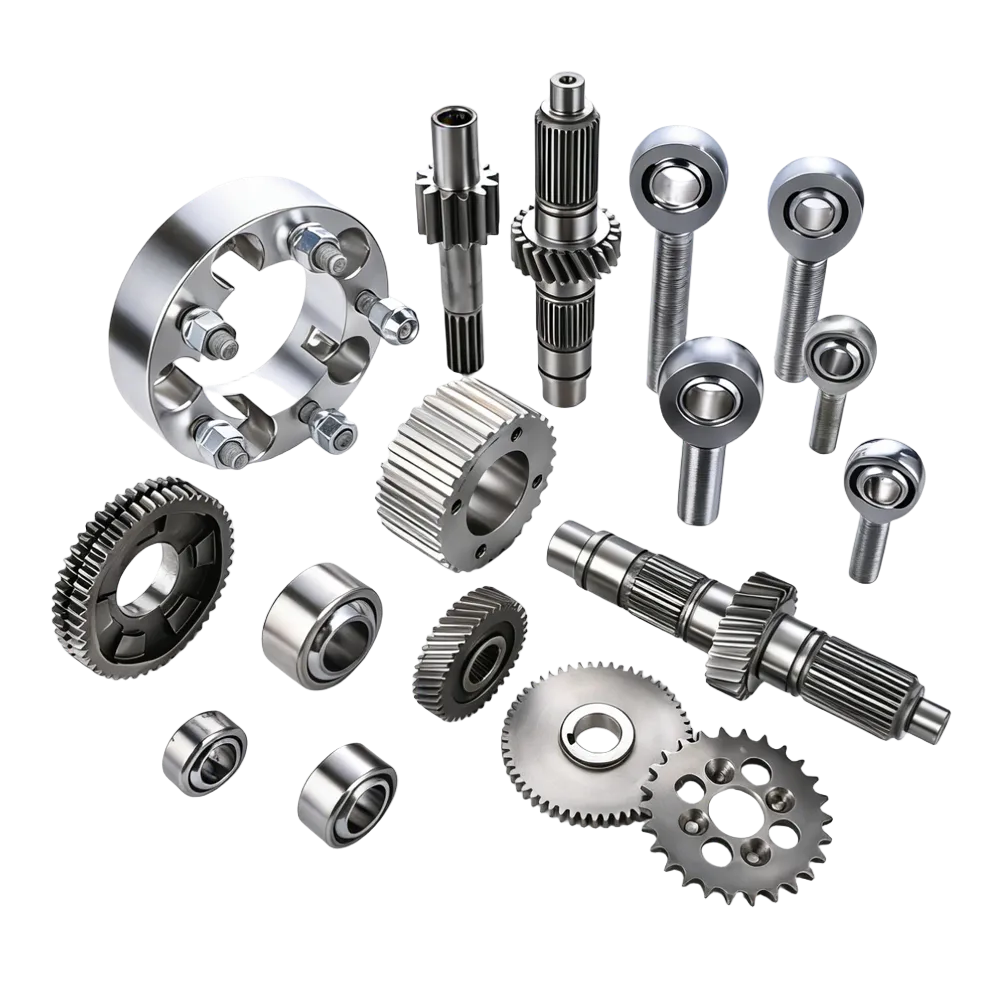
A bushing slides; a ball bearing rolls. Both support a shaft and reduce friction, but a bushing is a plain bearing — a simple sleeve the shaft slides directly against — while a ball bearing is a rolling-element bearing that uses balls between an inner and outer race to convert sliding friction into much lower rolling friction.
Construction: Simple Sleeve vs. Multi-Part Assembly
A bushing is typically a single, solid cylinder — one piece of bronze, steel, or a polymer, with the shaft rotating or sliding against its inner bore. A ball bearing is a multi-part assembly: an inner race, an outer race, a set of steel (or ceramic) balls, and a cage that keeps the balls evenly spaced. That structural difference is the root of nearly every other difference between them.
Comparison Table
| Factor | Bushing | Ball Bearing |
|---|---|---|
| Construction | Single sleeve, no moving internal parts | Inner race + outer race + balls + cage |
| Motion type | Sliding contact | Rolling contact |
| Friction | Higher | Much lower |
| Best speed range | Low to moderate | High |
| Load capacity | Handles heavy static/radial loads well across a large contact surface | Handles light-to-moderate loads well; heavy loads can deform the balls over time |
| Shock/impact tolerance | Good | More sensitive to shock and contamination |
| Cost | Lower | Higher |
| Maintenance | Often self-lubricating, low upkeep | Needs periodic grease/oil and clean conditions |
| Noise | Quiet | Can be noisier, especially if worn or contaminated |
| Space required | Compact, simple | Requires more components and space |
| Typical applications | Automotive control arms, hinges, heavy industrial machinery, hydraulic pumps | Wheel hubs, electric motors, bicycle hubs, cooling fans, skateboard trucks |
Decision Rule
- Choose a bushing when the application has limited space, needs to handle heavy loads at lower speeds, requires vibration/shock dampening, or calls for a low-cost part with fewer failure points.
- Choose a ball bearing when the application needs high rotational speed, precise rotational alignment, maximum efficiency, or minimal starting torque.
Terminology Note
Technically, a bushing is already a type of bearing (specifically a plain bearing). So when people ask “bushing vs. bearing” without further qualification, they usually mean this exact comparison — bushing vs. ball bearing (or another rolling-element bearing). If you want the broader version of this comparison covering all rolling-element bearing types, see Bushing vs. Bearing: What’s the Real Difference?.
Related reading: What Is a Bushing? Definition, Materials, and How It Works · Bushing vs. Bearing: What’s the Real Difference? · Sleeve Bearing vs. Bushing: Is There a Real Difference?