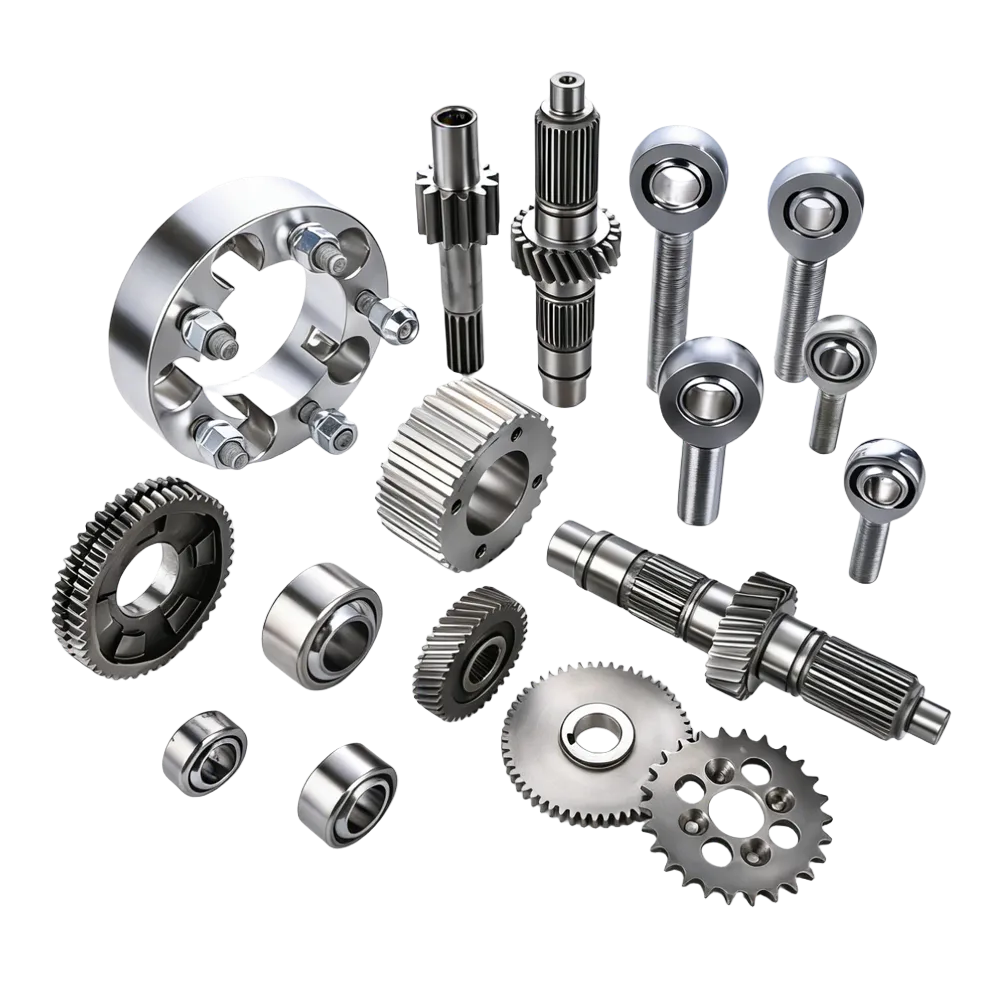

A sway bar end link transfers force from the suspension into the sway bar during cornering, letting the sway bar resist body roll. Without it, the sway bar is just a bar floating near the suspension — it can't twist against anything, so it can't do its job. The link is what turns the sway bar's torsional stiffness into an actual force acting on the wheels.
The Four-Step Sequence That Happens Every Time You Corner
- The car enters a turn. Weight shifts toward the outside wheels, compressing the suspension on that side.
- The outside control arm or strut moves upward as the suspension compresses, and the end link — bolted between that suspension component and the sway bar — pushes up on its end of the bar.
- The sway bar twists. Acting as a torsion spring, the bar resists that push, and the twisting force transmits across to the opposite end link — pulling the inside wheel's suspension upward too.
- Both sides are forced to move together, which is what flattens the body and keeps tire contact more even across the axle instead of letting one side dive while the other stays put.
A sway bar end link transfers vertical suspension movement into torsional resistance in the bar. The exact link design varies by vehicle, but the basic mechanical sequence is the same.
Link vs. Bushing — Not the Same Part
It's easy to mix these up because they're both small, both rubber-adjacent, and both part of the same system:
| Sway bar end link | Sway bar bushing | |
|---|---|---|
| Connects | Sway bar end ↔ suspension (control arm or strut) | Sway bar body ↔ frame/subframe |
| Job | Transfers force so the bar can act on the suspension | Mounts the bar to the chassis, allows it to twist in place |
| Both need to be | Sound, for the sway bar to do anything at all |
If either one fails, the sway bar's anti-roll effect is compromised — a bad link breaks the force path to the suspension, a bad bushing lets the bar shift or clunk against its mount. They're different failure points with different fixes, so it's worth being specific about which one you're actually dealing with before ordering parts.
Why the End Joints Are the Weak Point
Each end of the link has a joint — typically a ball joint or a rubber/polyurethane bushing — that lets the link pivot as the suspension moves. That joint is in constant motion under load every time the car corners or crosses uneven pavement, which is exactly the kind of dynamic, cyclical stress that wears components out faster than static load does. It's the engineering reason this small, inexpensive part is also one of the more frequently replaced suspension items — not a design flaw, just where the physical stress concentrates.
Related reading: What Is a Sway Bar Link in a Car? · What Is a Sway Bar Disconnect?