When to stick with Inch (SAE)
If you are building a Jeep, a buggy, or a hot rod, inch-sized Heims are the “Standard Language.”
- Compatibility: Most 4-link kits and tube adapters are designed for 3/4″, 7/8″, or 1-1/4″ shanks.
- Standards: These joints follow SAE J1120 geometry, which makes it easy to find replacement parts at any off-road shop in the US.
When to go Metric (ISO)
Metric joints are increasingly common in the global market.
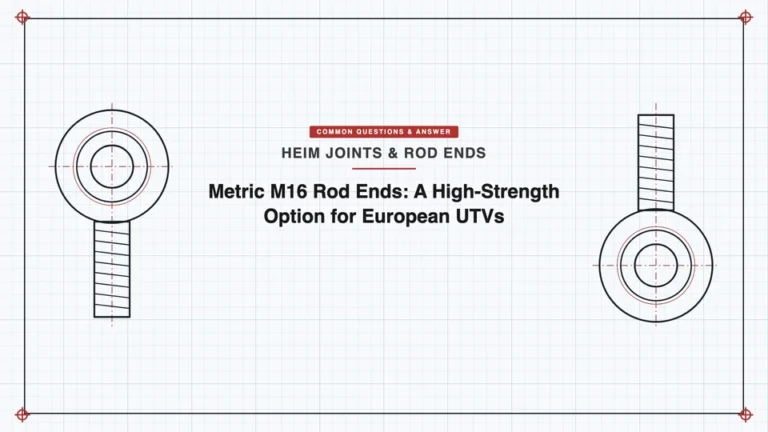
- OEM Upgrades: If you’re replacing a factory tie rod on a Toyota, BMW, or Polaris UTV, you’ll likely need an M14, M16, or M18 joint.
- Precision Engineering: Many modern CNC machines and automation tools are built on the metric system, requiring ISO 12240-4 compliant rod ends.
- The Rule: Never try to “near-match” them. A 12mm bolt will almost fit in a 1/2″ (12.7mm) hole, but that 0.7mm difference will cause a catastrophic “clunk” and eventually shear the bolt.
Related reading: Heim joint size chart: metric and inch specifications · Metric M16 Rod Ends: A High-Strength Option for European UTVs · 3/4-16 vs. 7/8-14: Choosing the Right Shank Size