
2-Piece: Simple and cost-effective
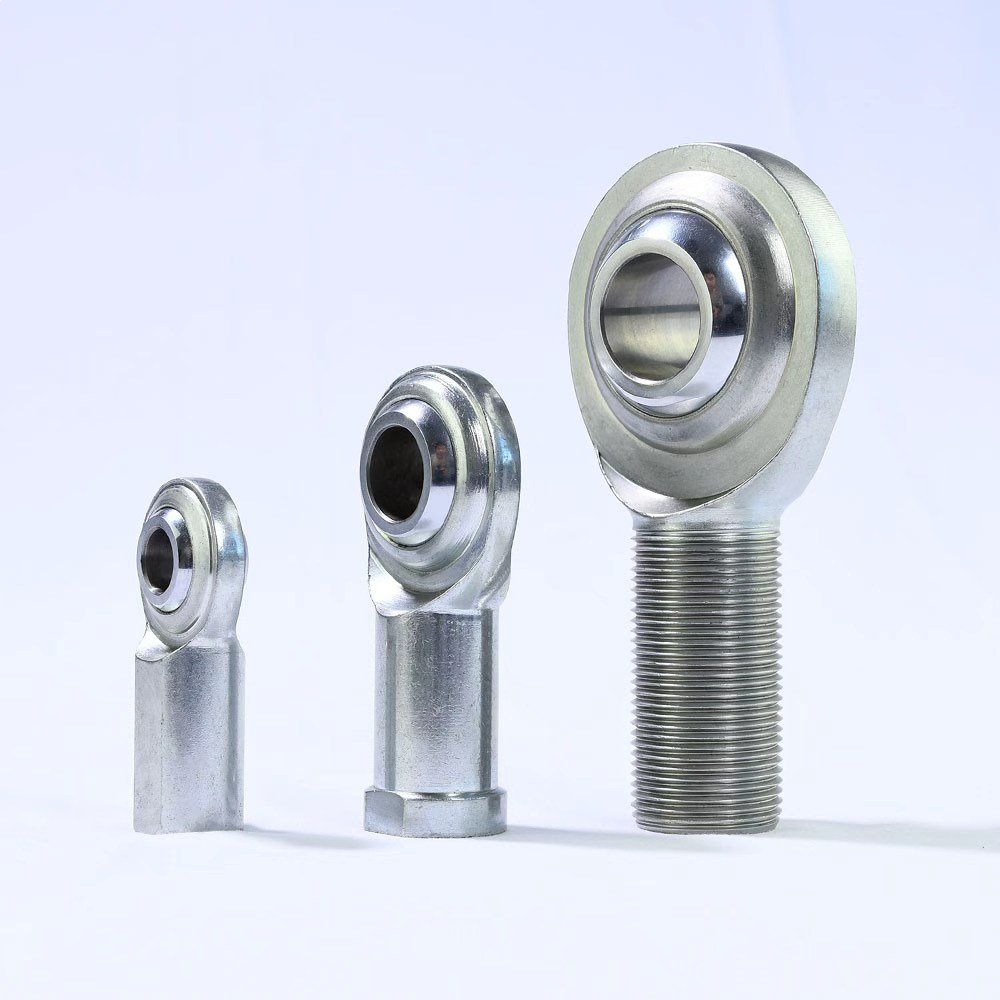
CM series male and female 2 piece rod endsA 2-piece Heim joint consists only of a housing and a ball.
- Construction: The housing is forged, the ball is inserted, and the housing is then swaged (deformed) around the ball.
- Limitations: These are usually “metal-on-metal,” meaning they require frequent lubrication. Because there is no separate race, any wear happens directly on the housing, which can lead to early failure in high-impact environments.
3-Piece: Precision and durability

This is the construction used for the SYZ JMX series.
- The Race: A separate race (usually brass or stainless steel) is inserted between the ball and the housing.
- The Liner: This design allows for a PTFE (Teflon) liner to be bonded to the race, providing a self-lubricating, zero-maintenance interface.
- Load Capacity: According to SAE J1120 benchmarks, 3-piece Chromoly joints maintain their structural integrity longer under high-frequency vibration than 2-piece carbon steel alternatives.
Related reading: What is a “slot loading” design in Heim joints? · Nylon Race vs. Metal-to-Metal: Choosing the Right Bearing Interface · What is a “self-lubricating” rod end?