
Modification forums regularly feature posts like: “My car is 5×114.3, I bought matching spacers—why won’t they install?” The issue typically traces to a critical oversight: many buyers focus exclusively on bolt pattern while overlooking center bore, thickness, and fastener specifications—parameters equally important. A complete wheel spacer size code appears like: “5×114.3-67.1CB-20mm-M12x1.5.” Each digit and character carries critical information. Misinterpreting this code risks purchasing incompatible products—best case causing installation delays, worst case creating safety hazards.
PCD – Bolt Pattern's Dual Information
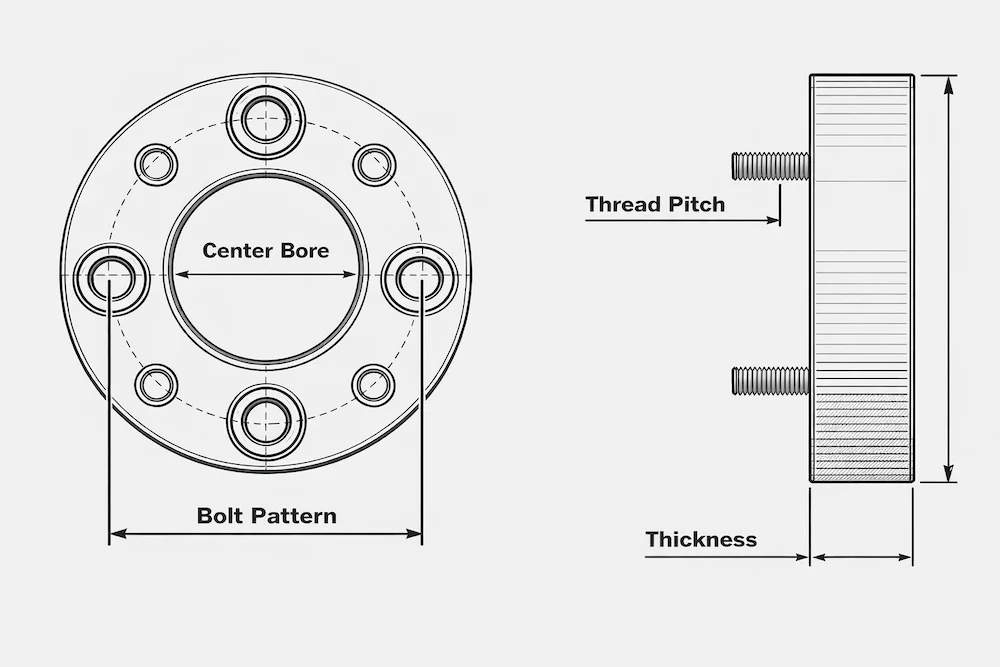
PCD represents Pitch Circle Diameter, using two numbers to describe bolt arrangement. For “5×114.3,” the first digit “5” indicates bolt hole count; the second “114.3” (in millimeters) represents the diameter of the circle formed by bolt hole centers.
Why 114.3 Rather Than a Round Number?
This seemingly unusual figure actually derives from imperial unit conversion. 114.3mm approximately equals 4.5 inches—a round number in imperial systems. Numerous Japanese and American vehicles employ this specification, including Honda, Mazda, Nissan, and Jeep models.
Similar “odd” numbers include:
- 5×100 (approximately 4 inches: Subaru, VW, etc.)
- 5×120 (BMW standard specification)
- 5×112 (Audi, Volkswagen, Mercedes common standard)
- 5×127 (American pickups and SUVs)
How to Measure PCD?
When uncertain about vehicle PCD, precise measurement techniques provide verification:
- 5-bolt wheels: Measure the distance between any adjacent bolt hole centers; multiply by 0.85
- 4-bolt wheels: Directly measure the distance between opposite bolt hole centers
- 6-bolt wheels: Measure the distance between opposite bolt hole centers
Caliper measurements must achieve 0.1mm precision. Even 0.5mm deviation creates high-speed problems. This explains why professional manufacturers develop dedicated tooling for specific PCD values rather than generic “universal” designs.
Mismatched PCD Consequences
Forcing incompatible PCD spacers places bolts under angular stress. This non-axial loading generates excessive bending stress at bolt roots, dramatically reducing fatigue life. Analysis of disassembled components reveals that forced installation with PCD deviation exceeding 2mm produces micro-cracking in bolts after 5,000-8,000 kilometers.
**Warning: Don’t Confuse Similar PCD Specs.
Many owners conflate 5×114.3 with 5×112. Never attempt forcing a 5×112 spacer into 5×114.3 wheels. Despite appearing “close enough,” this 2.3mm error generates extreme bolt shear stress, producing fatigue fractures during high-speed driving.
CB – Center Bore's Precise Alignment
CB denotes Center Bore—the spacer’s central hole diameter. This parameter must match vehicle hub external diameter with extreme precision (±0.05mm), not “approximately.”
Common CB Dimensions
Different manufacturers employ standard CB sizes:
| Brand | Common CB Sizes (mm) | Representative Vehicles | ||
|---|---|---|---|---|
| BMW | 72.6 | 3-Series, 5-Series, X3, X5 | ||
| Audi/VW | 57.1 / 66.6 | A4, Golf, Passat | ||
| Honda | 64.1 | Civic, Accord, CR-V | ||
| Toyota | 54.1 / 60.1 | Camry, RAV4, Corolla | ||
| Mazda | 67.1 | Mazda 3, 6, CX-5 | ||
| Jeep | 71.5 | Wrangler, Grand Cherokee |
Hub-centric versus Lug-centric Design
Hub-centric spacers rely on center bore to support vehicle weight and provide centering, with fasteners supplying clamping force only. This replicates original equipment design—the safest approach.
Conversely, lug-centric spacers feature oversized CB, depending on fastener tension for centering and load support. While theoretically viable, practical use presents hazards: fasteners experience combined shear and tensile forces, complicating stress patterns; if fasteners loosen, the system loses centering, producing vibration or separation.
Engineering conservatism dictates hub-centric selection as the only reliable choice. Certain budget spacers employ plastic centering bushings to compensate for oversized CB—a dangerous compromise. Plastic deforms under elevated temperature and sustained loading.
CB Diameter Problems
- CB undersized (smaller than hub diameter): Physical installation becomes impossible—actually preferable to prevent misinstallation
- CB oversized (larger than hub diameter): Installation succeeds but cannot achieve hub-centric centering; must rely on fasteners, increasing risk
- CB precisely matched: Ideal state—spacer seats firmly on hub with zero movement
Hub diameter measurement requires digital calipers or internal micrometers; tape measures or standard rulers lack sufficient precision.
Chamfer Detail: Frequently Overlooked Installation Hazard
Beyond diameter matching, attention to spacer back-surface chamfer dimensions proves critical. If the original hub root exhibits pronounced radius while spacer back lacks corresponding chamfer, the spacer cannot fully contact bearing surfaces. Resulting gaps cause fastbolt loosening under load. This represents a common cause of “data-correct yet vibrating” scenarios.
Professional manufacturers designing vehicle-specific spacers adjust for actual (not nominal) hub dimensions and ensure chamfer alignment with hub root characteristics. This constitutes true vehicle-specific design value.
Thickness – From Millimeters to Appearance and Performance Impact
Spacer thickness directly determines wheel outward projection distance. Market offerings range from 5mm to 50mm, yet application scenarios differ completely across ranges.
5-10mm: Fine-Tuning Tier
This thickness primarily addresses minor tire-to-suspension or brake caliper interference. After upgrading to BBK (big brake kits), original wheels might possess 1-2mm clearance deficit. A 5mm spacer solves this problem.
Appearance improvement remains minimal—unless crouching for close inspection, changes barely register visually. Avoid selecting this thickness purely for visual effect—value proposition proves inadequate.
12-20mm: Mainstream Range
This thickness bracket commands the largest market volume, balancing visual effect and driving impact. For 15mm example:
- Appearance: 15mm wheel outward expansion; if original wheels recessed significantly, this creates level alignment with fenders—visually obvious
- Track width: Front-rear track increases 30mm total (15mm per side), theoretically improving cornering stability
- Offset transformation: Original ET45 wheel + 15mm spacer = ET30 effective offset
At this thickness, steering effort and suspension geometry changes remain controllable. Most daily-driving users select this range.
25-50mm: Aggressive Tier
Spacers exceeding 25mm serve primarily two scenarios:
- Extreme appearance modification: Pursuing “aggressive” flush fitment (wheel face level with or protruding beyond fender)
- Special functional requirements: Off-road vehicles installing wider tracks to improve rollover stability
This thickness presents pronounced side effects:
- Tires may contact fender edges or interior trim (especially during steering or suspension compression)
- Wheel bearings and suspension ball joints experience increased lever torque, accelerating wear
- Steering effort increases noticeably
- ESC/ABS systems may require recalibration
- Suspension travel impact: Excessive spacer thickness alters suspension lever ratio, making springs appear “softer” and potentially causing tires to contact fenders before suspension reaches limits. After installing 25mm+ spacers, perform full-range compression testing to ensure maximum suspension travel avoids tire-body contact.
Without absolutely clear functional requirements, avoid exceeding 25mm thickness.
📏 Thickness Selection Guide
5–10 mm: Resolves clearance interference; minimal visual improvement
12–15 mm: Most commonly used; balances appearance and performance
20–25 mm: Noticeable outward stance; slight impact on handling
25 mm+: Aggressive look; requires evaluation of rubbing risk and bearing load
Bolt Specifications – Decoding M12x1.5
Complete size codes include bolt specifications like “M12x1.5” or “M14x1.25,” indicating thread diameter and pitch.
M12x1.5 Meaning
- M12: Metric thread, 12mm diameter (M = Metric)
- x1.5: 1.5mm pitch (distance between adjacent thread peaks)
Different vehicle types employ varying bolt specifications:
| Bolt Spec | Common Brands/Vehicles | Minimum Engagement Length | ||
|---|---|---|---|---|
| M12x1.5 | Honda, Mazda, Select Toyota | 18mm | ||
| M12x1.25 | Select Toyota, Lexus | 18mm | ||
| M14x1.5 | BMW, Audi, VW, Mercedes | 21mm | ||
| M14x1.25 | Select Nissan, Infiniti | 21mm | ||
| 7/16"-20 | Some American Vehicles | 0.66" |
Bolt-on versus Slip-on Design
- Bolt-on spacer: Includes pre-installed fasteners; the spacer mounts to the hub first, then original fasteners attach the wheel to spacer
- Slip-on spacer: Lacks fasteners; spacer slides directly onto hub; extended fasteners pass through spacer to secure wheel
Bolt-on design proves safer—if wheel fasteners accidentally loosen, the spacer remains hub-mounted. This requires dual fastener sets, increasing cost. Slip-on design simplifies assembly but demands precise fastener length and quality.
Fastener Length Calculation
Slip-on spacer use requires extended fasteners. Length calculation formula:
New fastener length = Original fastener length + Spacer thickness + 3mm safety margin
Thread engagement depth must achieve minimum 1.5 times bolt diameter. For M14 fasteners, 21mm minimum engagement proves necessary. Installing 20mm spacer with only 20mm additional fastener length creates insufficient engagement, producing thread-stripping risk.
Professional manufacturers clearly specify required fastener length on product pages, often supplying matched extended fasteners. Vague fastener length descriptions represent danger signals.
Critical Note: Torque Management
Specifications determine sizing, but torque determines life. When installing bolt-on spacers, employ a torque wrench ensuring proper clamping force (M12 typically 110-130 Nm; M14 typically 140-160 Nm). Over-tightening damages threads; under-tightening fails to secure properly. Regardless of design type, perform re-torque inspection after 100 kilometers to confirm fasteners remain within specification torque range.
ET Values and Offset – Understanding Wheel Outward Extension
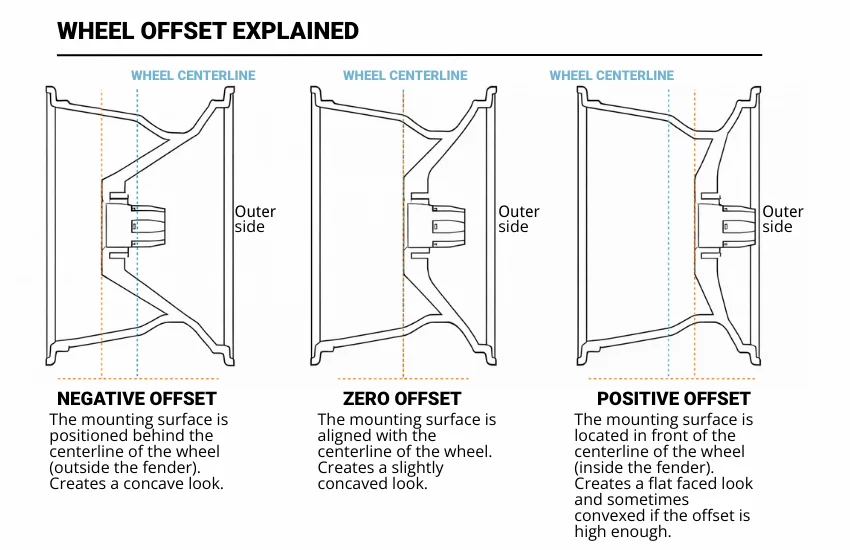
ET (German “Einpresstiefe”) represents Offset in English—the distance from wheel mounting surface to wheel centerline.
ET Value Sign Meanings
- Positive ET (example ET45): Mounting surface positioned outside centerline (toward exterior); wheel sits deeper within fender
- Zero ET (ET0): Mounting surface exactly at centerline
- Negative ET (example ET-10): Mounting surface positioned inside centerline; wheel protrudes significantly
Most OEM vehicles employ positive ET values, ranging from ET35 to ET55. Modification lowers ET (reduces numerical value), moving wheels outward.
Spacer Effect on ET
The formula proves straightforward: New ET = Original ET – Spacer thickness
Examples:
- Original ET45 wheel + 15mm spacer = ET30
- Original ET38 wheel + 20mm spacer = ET18
Every 10mm ET reduction moves wheels outward 10mm. This directly affects:
- Scrub radius: Influences steering feel and straight-line stability
- Track width: Affects cornering stability
- Tire-to-fender clearance: Excessive outward movement causes rubbing
From engineering perspective, ET variation within ±20mm presents acceptable suspension geometry effects. Beyond this range, consult professional modification specialists or perform four-wheel alignment adjustment.
Complete Size Code Example Analysis
Now combining all elements, decode actual size codes.
Example 1: “5×114.3-67.1CB-15mm-M12x1.5-Forged 6061-T6-Anodized”
- 5×114.3: 5 bolt holes; 114.3mm pitch circle diameter (Honda, Mazda compatible)
- 67.1CB: 67.1mm center bore diameter (Mazda standard specification)
- 15mm: 15-millimeter thickness; ET value reduction of 15
- M12x1.5: Matched bolt specification M12; 1.5mm pitch
- Forged 6061-T6: Forged 6061-T6 aluminum alloy material
- Anodized: Anodized surface treatment
This represents a standard mid-thickness Japanese vehicle spacer configuration.
Example 2: “5×120-72.6CB-20mm-M14x1.25-7075-T6-Hard Anodized-Bolt-on”
- 5×120: 5-hole pattern; 120mm pitch circle diameter (BMW standard)
- 72.6CB: BMW standard center bore
- 20mm: Thicker design; pronounced outward extension
- M14x1.25: BMW-standard bolt specification
- 7075-T6: Aerospace-grade high-strength aluminum alloy
- Hard Anodized: Hard anodizing (more durable than standard anodizing)
- Bolt-on: Integrated fastener design; safer installation
This represents premium BMW performance vehicle spacer configuration with top-tier material and processing.
Example 3: “6×139.7-108CB-25mm-M12x1.5-Forged-Dacromet Studs”
- 6×139.7: 6-hole design (truck and SUV common)
- 108CB: Large center bore (matches heavy-duty vehicle hubs)
- 25mm: Aggressive thickness for off-road modifications
- M12x1.5: Mid-range bolt specification
- Forged: Forged manufacturing process
- Dacromet Studs: Fasteners employ Dacromet corrosion protection (off-road essential)
This represents heavy-duty off-road-optimized configuration with thickness and corrosion protection addressing extreme environment demands.
Purchase Verification Checklist
Upon encountering spacer product pages, verify every item:
- Does PCD match vehicle precisely? Distrust “universal 5-bolt” claims
- Is CB specifically specified? Require exact values (67.1mm), not ranges (65-70mm)
- Does thickness suit requirements? Solves interference without excessive outward extension
- Are bolt specifications clear? Do slip-on models supply extended fasteners or specify required length
- Are materials and processes designated? Forged/CNC billet surpasses cast
- Surface treatment type? Anodized exceeds painted or untreated
- Hub-centric design? Must ensure hub-centric; avoid lug-centric
Should any information prove absent or ambiguous, contact the supplier for clarification. Professional manufacturers provide detailed fitment guides, even specifying recommendations for precise vehicle models (example: “2022 Mazda 3 2.5T”).
Engineering and Safety Behind the Code
Wheel spacer size codes represent more than arbitrary numbers—they embody precision engineering. Each parameter carries specific physical significance and safety implications:
- PCD ensures balanced bolt loading without abnormal stress
- CB guarantees hub centering, eliminating vibration and eccentric loading
- Thickness balances appearance, performance, and safety across multiple dimensions
- Bolt specification determines engagement strength, preventing thread-stripping and loosening
- ET variation impacts handling characteristics and tire-rub risk
Mastering these codes enables purchasing genuinely compatible products while avoiding defective merchandise using vague specifications to mask quality issues. Within spacer markets, “approximately correct” and “should work” represent dangerous philosophies—either perfect specification match or complete avoidance.
For users requiring professional matching and customization, selecting manufacturers offering vehicle-specific solutions and comprehensive technical support proves critical. Complete, precise size codes represent the primary professional indicator.