Wholesale Aftermarket Parts & Accessories for ATV/UTV, Off-Road
Belt transmission
Friction-type Belt Transmissions & Synchronous Belt Transmissions
DN
By: Danny Ni
·Published: October 26, 2021·3 Min Read
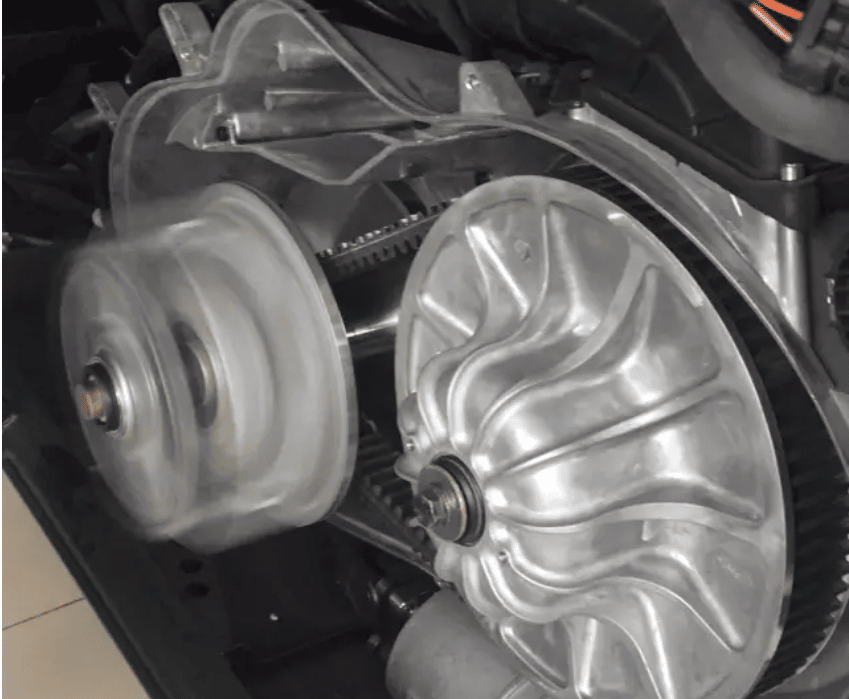
Belt transmission is a widely used mechanical system that relies on a flexible belt tensioned around pulleys to transmit motion or power. Depending on the working principle, belt transmissions are classified into friction-type and synchronous-type systems.
Belt drives can be found across many industries, including general machinery, automobiles, agricultural equipment, and household appliances, thanks to their versatility and reliability.
Friction-type Belt Transmissions
Among all friction-type systems, the V-belt drive is the most common.
Design
The V-belt has an isosceles trapezoid cross-section, and the pulley is designed with corresponding grooves. During transmission, only the two slanted sides of the belt are in contact with the pulley; the bottom surface does not touch.
Principle
Based on groove friction, the V-belt generates greater friction than a flat belt under the same tension. This gives it a stronger transmission capacity while maintaining a compact design.
Advantages
Easy to install and replace
Requires less installation space
Offers high transmission efficiency
Produces lower noise levels
Because of these benefits, V-belt drives hold a significant position in the entire transmission field.
Synchronous Belt Transmissions
Another important type is the synchronous (timing) belt transmission.
Design & Operation: A synchronous belt transmits motion through the meshing of evenly spaced transverse teeth on the inner surface of the belt with corresponding grooves on the pulley.
Advantages: Unlike friction-based systems, synchronous belts eliminate slippage, ensuring a strict and precise transmission ratio.
Limitations: This type of belt requires a larger center distance and higher dimensional stability, which may restrict its use in compact or flexible setups.
Friction-type vs. Synchronous Belt Transmissions
Feature
Friction-type (V-belt)
Synchronous Belt
Transmission Principle
Relies on groove surface friction
Relies on tooth meshing
Precision
Moderate, slight slippage possible
Very high, no slippage
Power Capacity
Strong, compact structure
Stable but depends on dimensional accuracy
Noise Level
Low
Slightly higher
Installation
Easy, less space required
Requires precise alignment & larger center distance
Both friction-type and synchronous-type belt transmissions are crucial in mechanical power systems.
Friction-type (V-belts) excel in compact, efficient, and quiet operations.
Synchronous belts provide precision and stability where exact transmission ratios are critical.
Understanding the differences helps engineers and users choose the right system for specific applications, ensuring both efficiency and performance.
Belt transmission is a mechanical transmission that uses a flexible belt tensioned on a pulley to perform movement or power transmission. Base on different transmission principles, there are friction-type belt transmissions and synchronous belt transmissions. According to different uses, there are transmission belts for general industrial use, automobiles, agricultural machinery and household appliances.
About the friction-type belt transmissions, the most widely used is the V-belt drive.
The cross section of the V-belt is an isosceles trapezoid, and the pulleys are also made into corresponding grooves. During transmission, the V-belt only contacts the two sides of the groove. It means that the two sides of the V-belt are working surfaces, and the bottom surface of the belt does not contact the pulley.
According to the friction principle of the groove surface, under the same tension, the V-belt drive can produce greater friction than the flat belt drive. Therefore, the V-belt has a strong transmission capacity and a more compact structure.
Compared with flat transmission belts, V-belt has the advantages of easy installation, small footprint, high transmission efficiency and low noise, and it occupies an important position in the entire transmission field.
And other type of belt transmission is called synchronous belt transmissions. The synchronous belt transmissions driven by the meshing of the teeth on the belt and the pulley.
It transmits movement through the meshing of transverse teeth distributed equidistantly on the inner surface of the transmission belt and corresponding tooth grooves on the pulley.
Compared with friction-type belt transmission, there is no relative sliding between the pulley and the transmission belt of the synchronous belt transmission, which can ensure a strict transmission ratio. However, the synchronous belt drive requires high center distance and dimensional stability.
JuneDigital Marketing Supervisor
I work as online marketing specialist in SYZ Machine, sharing insights on ATV, UTV, off-road, racing, and motorcycle aftermarket parts, helping industry buyers and engineers choose reliable components for performance and durability.
We use cookies for essential site functions, RFQ workflows, traffic measurement, and improving technical content for global sourcing teams. You can accept all cookies, use only necessary cookies, or manage preferences in our Cookies Policy.
Cookie Preferences
Choose how SYZ Machine may use optional cookies. Strictly necessary cookies support security, page delivery, and core website functions and cannot be switched off here.
Strictly Necessary Cookies
Required for security, page delivery, session handling, and core quote-request functionality. Always active.
Analytics & Performance
Helps us measure visits, traffic sources, and page performance so we can improve product and engineering content.
Functional Preferences
Supports enhanced preferences such as remembered form context, language choices, or catalog browsing settings where available.
Marketing & Targeting
Allows advertising and remarketing platforms to tailor sourcing-related messages and measure campaign performance.