
If you enjoy watching rock crawling videos, you’ve undoubtedly been impressed by the exaggerated wheel travel and the crossed axles of the rigs. Let’s start by watching a video of a rock crawler defying gravity:
Source – Youtube creator Shock Surplus
Rock Crawling has never been about speed. It is about how to keep four wheels on the ground at angles that seem impossible. It is about dissolving the resistance of rocks through the chassis’ insane “Articulation” at a remarkably slow pace.
Therefore, in the world of rock crawler modification, articulation is an art. Today, we will explore how to master this art through the right build philosophy and component selection.
I. Suspension System
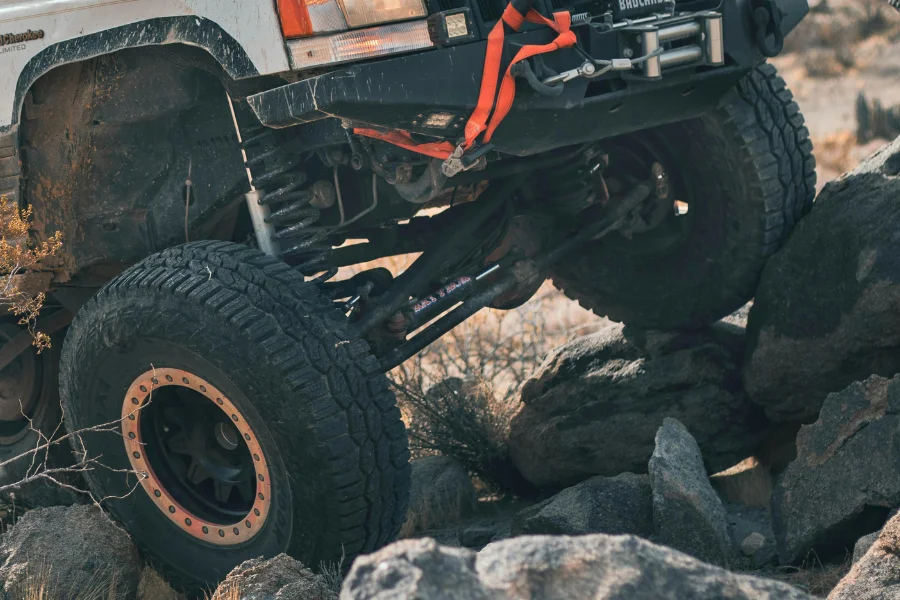
In rock crawling, the most important rule is to keep all four tires on the ground as much as possible. As soon as a tire lifts, you lose traction. However, the rock roads crawlers navigate (if they can even be called roads) are extremely uneven. Imagine a crawler’s front right tire hitting a two-foot boulder: it must be compressed upwards to the extreme (Stuffed), while simultaneously, the front left tire must extend downwards (Droop) until it finds traction.
Source – pexels
In this extreme environment, the vehicle needs exaggerated suspension flexibility, commonly known as “Flex” or “Articulation.”
Factory suspension is usually powerless to achieve this. We need to build a brand-new system from the ground up:
1. Solid Axle
Imagine a rigid barbell connecting the left and right wheels. When the left wheel is forced up by a rock, the lever principle naturally “presses” the right wheel down into the ground. This physical characteristic makes the solid axle the foundation of a rock crawler.
2. Triangulated 4-Link System Parts
Once we have a solid axle, we need to “hang” it under the vehicle. Traditional leaf springs or 3-Link systems often limit travel due to structural constraints (like the Panhard Bar).
The greatest advantage of a 4-Link suspension system is “Geometric Unbinding.” By arranging the upper links in a triangulated configuration, the axle’s lateral movement is physically locked, allowing you to completely ditch the Panhard Bar. This means your axle is no longer tethered by lateral drag, allowing it to twist freely—like a dislocated joint—extracting every inch of travel from your shocks.
To build such a system (using a double triangulated 4-link suspension kit for rear axle as an example), we need:
4x Lengths of Tubing: Usually DOM tubing that made from chromoly steel. This is the skeleton of the 4-link system.
8x Heim Joints: Factory rubber bushings will bind or tear at extreme angles. Heim Joints allow the links to rotate freely in multiple degrees. Although they may produce some mechanical noise, they ensure the suspension cycles as smooth as silk.
16x High Misalignment Spacers: Standard rod ends have limited angle. Adding these specific spacers can instantly expand the range of motion to over 60 degrees, preventing metal-on-metal binding.
8x Jam Nuts: Their role is to “freeze” your settings. Without them tightening down hard, the intense vibrations of rock crawling will loosen your links, throw off your suspension geometry, or even cause links to fall off.
8x Tube Adapters: These are the bridge between the “hollow tubing” and the “precision joint.” One end slides into the tube for high-strength welding, and the other provides precision threads for the Heim Joint to screw into.
- 1 x Flush Mount Lower Triangulated Bracket: Welds to the crossmember. Provides a snag-free, high-strength mounting point for triangulated lower links without sacrificing ground clearance.
- 1 x Axle Link Mount Pair (20 Degrees): Welds to the axle tubing. Angled at 20 degrees to align perfectly with the links, preventing heim joint binding during extreme articulation.
- 1 x Truss Link Mount Brackets: Sits on top of the axle truss. Serves as the mounting point for the converging upper links, completing the rear triangulation.
- 2 x Adjustable Inner Frame Link Mounts (20 Degrees): Welds to the inner frame rails. Features multiple mounting holes, allowing you to fine-tune your suspension geometry (Anti-Squat) for different climbing scenarios.
If you are building this system for a front axle, you will typically run a single triangulated 4-link configuration due to clearance issues with the engine, oil pan, and driveshaft.
In a single triangulated setup, the lower links run parallel to the frame (straight), while the upper links remain triangulated. Therefore, you need to adjust the bracket list above:
REMOVE:
- 1 x Flush Mount Lower Triangulated Bracket
- 1 x Axle Link Mount Pair (20 Degrees)
ADD instead:
- 2 x Outer Frame Link Mounts
- 1 x Axle Link Mount Pair (0 Degrees / Vertical)
3. Pro Tip: Fine-tuning Your 4-Link System
When climbing steep rock faces, the suspension geometry must prevent the front end from lifting too much (unloading). This requires frequent adjustments to link lengths to optimize Anti-Squat percentages.
To make fine-tuning easier without removing the links every time, we strongly recommend your parts list follow the “Symmetrical Principle”:
8x Heim Joints: Split into 4 Left Hand + 4 Right Hand
8x Jam Nuts: Split into 4 Left Hand + 4 Right Hand
8x Tube Adapters: Split into 4 Left Hand + 4 Right Hand
Why this recommendation? This utilizes the “Turnbuckle” principle. Like the principle demonstrated by the image below, when one end of the link is Right-Hand Thread (RH) and the other is Left-Hand Thread (LH), you only need to rotate the steel tube with a pipe wrench:
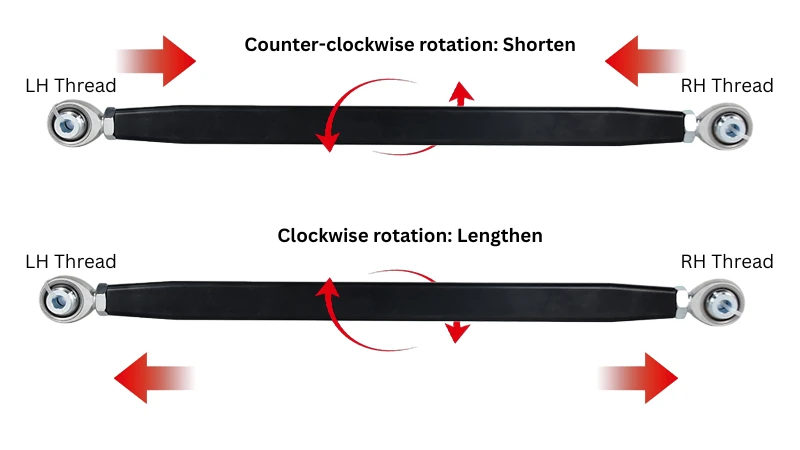
Clockwise: Both joints retract simultaneously (Link lengthens).
Counter-Clockwise: Both joints extend simultaneously (Link shortens).
This means when you’re on the trail and notice your Pinion Angle is off, you can precisely adjust the suspension length while lying under the rig without removing a single bolt. This is the efficiency of a professional build.
4. Coil Springs vs. Coilovers
When you have a 4-Link system capable of moving an axle 14 or 16 inches, factory short shocks simply can’t keep up. You can choose between these two options:
Coil Springs + Long Travel Shocks: A high value entry-level solution. However, the separated structure has a fatal flaw in extreme crawling—”Unseating” (dropping a spring). When the suspension droops to the limit, the spring can come loose or fall out. While retainers can be used, mounting them often conflicts with complex 4-Link spacing.
Coilovers: The ultimate performance choice. It combines the spring and shock into one compact unit, saving chassis space for those 4 beefy links. Additionally, they feature Dual-Rate Springs: a soft spring handles small bumps and helps the tire droop, while a stiff spring provides support during big hits or compression.
5. Limit Straps
These are high-strength nylon straps set 1 inch shorter than the shock’s maximum extension. Before the suspension reaches full droop, the strap pulls tight, taking the weight of the axle. This protects your shocks, brake lines, and expensive Heim Joints from being pulled apart.
II. Steering System
The suspension system unlocks “Flex,” but we also need to modify the steering system.
Imagine when one side of your suspension droops 20 inches deep; the axle moves further away from the frame. However, the Drag Link connecting the steering box to the wheel has a fixed length. When the suspension extends significantly, the short drag link acts like a tight rein, forcibly pulling the wheel to turn.
What’s the result? You didn’t move the steering wheel, but the tires turned themselves. This is the notorious bump steer. In a rock crevice, this sudden phantom force is strong enough to snap your thumb or shear off the steering box sector shaft.
The Ultimate Solution: Full Hydraulic Steering. As mentioned earlier, we recommended a triangulated 4-Link system. Because the panhard bar is removed, traditional mechanical steering (Steering box -> Drag link -> Knuckle) can no longer be used. It must be replaced with Full Hydraulic Steering.
Full Hydro completely ditches mechanical linkages, using hydraulic hoses to connect the helm to a Double Ended Ram mounted on the axle which pushes the wheels directly. It has two major advantages:
Geometric Unbinding: Connected only by flexible hoses, the steering is unaffected no matter how crazy the suspension twists.
Massive Power: Even if 40-inch tires are wedged in a crack, the hydraulic force can muscle the wheels to turn.
Since the hydraulic ram exerts massive force, standard single-bolt connections are extremely dangerous. You must use 3/4” Heim Joints paired with Double Shear Brackets to connect the ram to the knuckles.
III. Drivetrain
In a rock crawler, drivetrain modification isn’t about speed; it’s about two things: Extreme Torque Multiplication and Geometry that adapts to articulation.
1. Crawl Ratio: Snail Speed, Bulldozer Torque
We aim for extremely high crawl ratios (e.g., 100:1). Engine turns 100 times, wheel turns 1 time. To achieve this:
Transfer Case: Upgrade low range gears (e.g., 4:1).
Ring & Pinion: Swap for lower gears (numerically higher, e.g., 5.38:1) to drive big tires.
2. Lockers: The Ticket to Off-Roading
Factory “Open Differentials” send power to the wheel with the least resistance. As soon as one tire is in the air, you go nowhere. Differentials lockers lock the left and right wheels together, ensuring they spin at the same speed.
Types: Selectable Lockers (ARB/E-Locker), Auto Lockers, and the simplest brute-force method: The Lincoln Locker (Welded Diff).
3. Driveshaft & Geometry (Clocking the Axle)
When the suspension undergoes exaggerated articulation, the drivetrain faces two challenges:
Length Change: As the suspension droops, the axle moves away, requiring a custom Long Spline Driveshaft to prevent it from pulling apart.
Pinion Angle Conflict: When the suspension droops too deep, the angle between the driveshaft and differential becomes too steep, causing U-joints to explode.
Solution: Using the LH/RH Adjustable Link Assembly recommended above, you simply rotate the Upper Links to extend them. This pushes the top of the axle back, “Clocking” the axle housing so the pinion tilts upward, pointing directly at the transfer case to minimize the angle.
IV. Armor & Protection
In Rock Crawling, collisions with rocks are not a possibility; they are a certainty.
Skid Plates: Create a “Flat Belly”. Use high-strength steel or aluminum to seal the bottom, protecting the transfer case and oil pan. It’s not just a shield; it’s a “sled” that allows the vehicle to slide over rocks using momentum.
Rock Sliders: Protect the rocker panels. In the hands of a pro, they are also a turning tool—pivoting around a rock to swing the rear end around tight corners.
Roll Cages: Using triangulated geometry to build an incompressible survival space inside the cabin. This is your lifeline in a hard rollover.
V. Tires & Wheels
In Rock Crawling, the core of wheel modification is: Lower Pressure and Stronger Locking.
1. Low Pressure & Beadlocks
We need to drop tire pressure to single digits (5-10 PSI), allowing the tire to envelope rocks like a gummy bear, multiplying traction. To prevent the tire from popping off the rim (de-beading) at low pressure, you must upgrade to Beadlock Wheels. These physically clamp the tire bead to the wheel using an outer ring and high-strength bolts.
2. The Cost of Size
There is a saying in the crawling world: “Bigger is Better.” But bigger tires act as a giant lever. If your link system strength doesn’t keep up, the massive torque will snap your suspension like a twig. The larger the tire, the stronger the connection materials must be.
VI. Material Selection
As mentioned, extreme off-roading demands bulletproof strength against high torque, frequent impacts, and chassis twisting.
Among the professional clients served by SYZ Machine, a standard “Bulletproof” link system typically follows these material standards:
Tubing: 4130 Chromoly DOM Tubing. This is the skeleton. Compared to mild steel, Chromoly has incredibly high yield strength and memory—it resists bending under impact.
- Tube Adapters: 4130 Chromoly. To achieve a perfect weld with the 4130 tubing, the adapter material must match.
Heim Joints: Heat-Treated 4130 Chromoly Housing + 52100 Bearing Steel Ball. This is the core— paired with a Teflon/PTFE Liner for self-lubrication and longevity.
High Misalignment Spacers: Stainless Steel (303/304). Spacers need to be hard, but more importantly, rust-proof. Stainless prevents the spacer from seizing to the ball in muddy conditions, keeping the joint smooth forever.
Jam Nuts: Zinc Plated Heavy Duty Steel. Provides powerful clamping force with zinc plating for corrosion resistance.
Conclusion
Rock Crawling is a sport of balance. It requires the physical foundation of a Solid Axle, the geometric freedom of a 4-Link, the powerful control of Hydraulic Steering, the flexible grip of Low-Pressure Tires, and the rigid support of chromoly steel.
Every link in this chain matters. A single weak point will leave you stranded at the bottom of that crucial obstacle, no matter how experienced the driver may be.
At SYZ Machine, whether you need to build a complex 4-Link system or simply want to upgrade to a steering tie rod that won’t bend, our Fabrication Parts provide the support you need to conquer those seemingly impossible angles.
Before the build begins, it’s important to understand that not every off-road vehicle is designed to handle extreme articulation and structural load. If you’re still undecided about which vehicle to choose as the right platform, we break it down in detail in Which Vehicles Actually Make Sense for a Rock Crawler Build?