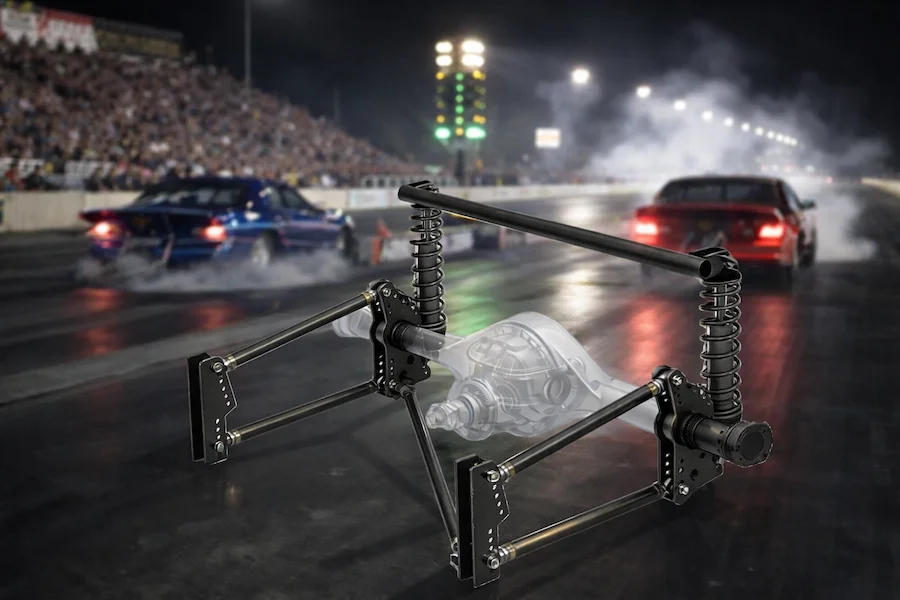
What Types of 4-Link Systems Are Out There?
Double Triangulated 4-Link: Both upper and lower arms are triangulated—the most complex but most stable design. Best suited for high-end street cars and show cars. If you’re after visual impact at car shows and daily driving stability, this is a solid choice.
Triangulated Upper 4-Link: Only the upper arms are triangulated, eliminating the need for a Panhard bar. This is the most common street setup. Classic applications like Fox Body Mustangs use this design extensively. But it has a fatal flaw: once the upper arm angles are welded in place, the instant center (IC) and anti-squat percentage are essentially locked. Once installed, they’re set in stone. Want to fine-tune for different track conditions? Basically impossible.
Parallel 4-Link: Upper and lower arms run parallel—the simplest structure, beginner-friendly. But it requires a Panhard bar or Watts link to control lateral movement. And because the arms are parallel and don’t intersect, there’s technically no true instant center. This means adjustment range is extremely limited—you can only change spring rates and shock valving, but geometry parameters are fixed.
Satchel Link: A relatively niche hybrid design mainly used to solve specific packaging constraints, like when fuel tank and exhaust positioning in certain truck builds is particularly tight. Not many real-world applications, and tuning knowledge is scarce.
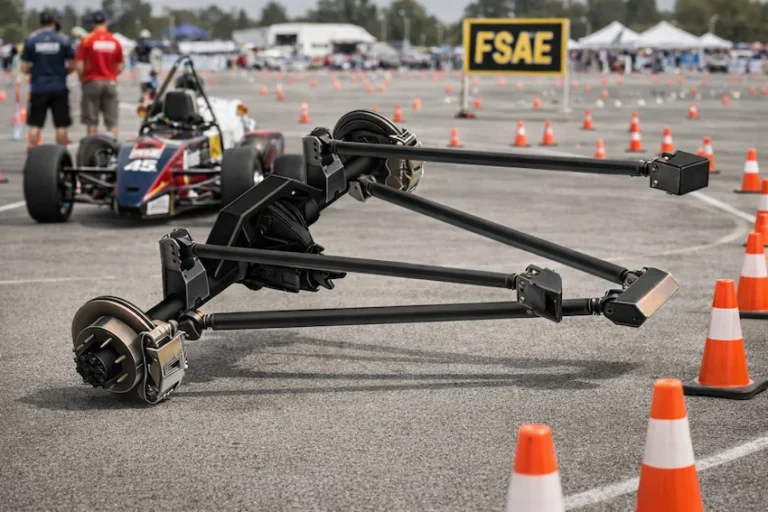
Drag Race 4-Link: Looks similar to a parallel setup at first glance, but the devil’s in the details—every single link is fully adjustable, and both chassis-side and axle-side brackets have multiple mounting holes (typically 6 to 15 positions). This means you can precisely control instant center position (both length and height) and anti-squat percentage. This is the fundamental difference from the other four systems: other systems are “one-and-done” after installation, while drag race 4-links give you a platform you can repeatedly fine-tune.
Simply put, the first four systems share a common trait: geometry parameters are basically fixed, with minimal adjustment room after installation. The core value of a drag race 4-link comes down to two words: adjustability. For more details of pros and cons of these types of 4-link suspension, check the custom 4-link suspension.
The "Superpower" of Drag Race 4-Links—Why Does Adjustability Matter So Much?
At this point you might ask: adjustable is adjustable, but is the difference really that significant? The answer: in drag racing where 0.01 seconds separates winners from losers, the difference is bigger than you can imagine.
What Is Instant Center (IC)?
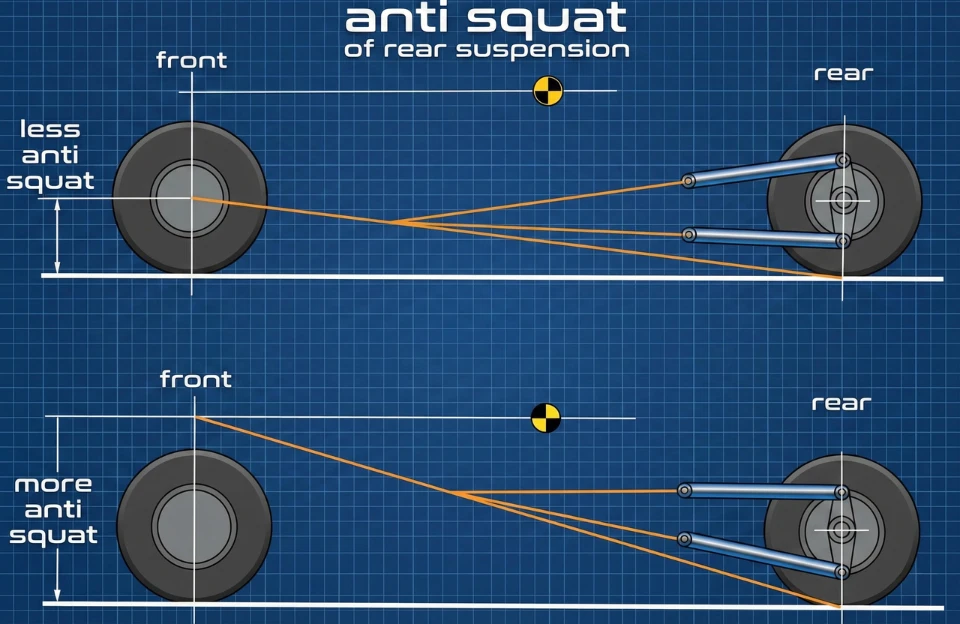
Instant center sounds academic, but think of it like pushing a refrigerator: push at the top and it wants to tip over; push at the bottom and you have to use tremendous force just to budge it; push at some middle height and it’s easiest to move while staying stable. The 4-link’s instant center is that “optimal push point”—when viewed from the side, the upper and lower link lines extend and intersect at a specific location. That intersection is the instant center.
Two Critical IC Parameters
Instant Center Length (IC Length): This is the horizontal distance from the IC to the rear tire contact patch. A long IC means smooth, progressive power delivery—ideal for low-prep tracks or endurance racing where tire wear matters. A short IC means aggressive, violent transfer—perfect for high-prep tracks and chasing ultimate 60-foot times. Typical values range from 20 inches to 100+ inches.
Instant Center Height (IC Height): This directly relates to anti-squat percentage. In drag racing, there’s a critical concept called “Anti-Squat 100% line”, commonly known as the “neutral line.” This line runs from the rear tire contact patch to the vehicle’s center of gravity height—it’s a dividing line:
- Anti-Squat < 100% (IC below neutral line): Rear squats on launch, tires are “gently” pressed into the pavement—good for low-grip tracks
- Anti-Squat = 100% (IC exactly on neutral line): Theoretically the chassis stays level, neither squatting nor rising
- Anti-Squat > 100% (IC above neutral line): Rear rises on launch (called “Separation” in the industry), tires are “aggressively” planted—ideal for high-grip tracks
Based on tuning cases I’ve seen, automatic transmission cars typically set IC height at 1-2 inches (corresponding to roughly 80-110% anti-squat) because automatic power delivery is relatively smooth. High-power manual transmission cars (especially clutch launches) need 3-7 inches IC height (corresponding to 120-150% anti-squat) to handle the shock of sudden clutch engagement.
Why Such Precise Adjustment Is Needed
Because every variable keeps changing.
Track conditions vary: High-prep tracks (sprayed with VHT traction compound, grip off the charts) and no-prep tracks (basically regular asphalt) demand completely opposite suspension geometry. On high-prep you can run short IC and high anti-squat—hammer the tires hard because the surface can handle it. Try that on no-prep? Tires turn into smoke machines. You need long IC and low anti-squat for gentler power transfer.
Vehicle configurations vary wildly: Should a 350hp street car and a 2000hp Pro Mod have the same suspension setup? The former might need more aggressive settings to extract every bit of power. The latter actually needs to limit violent suspension reactions to keep the tires from bouncing off the ground.
Transmission type matters: Manual cars with clutch launches experience massive instantaneous shock—they need higher IC to absorb the hit. Automatics or trans-brake cars have smoother power delivery and can run lower, longer IC.
Tires have their say too: Drag radials have relatively stiff sidewalls. Slicks have sidewalls soft as sponges. Soft sidewalls act like “suspension” themselves, so slick-equipped cars often need limited suspension travel with IC near the neutral line. Drag radials can tolerate more suspension movement.
Quick Reference Data
- High-power cars (1500hp+): IC near neutral line (Anti-Squat 100-110%), limit suspension travel to prevent tire bounce
- Mid-power (600-1200hp): IC height 1-3 inches (Anti-Squat 90-120%), most common competition setting
- Low-power (<500hp): IC below ground acceptable (Anti-Squat 60-80%), use long IC (70-100+ inches) to compensate for power deficit
- Manual transmission: Anti-Squat +10-20% (vs same-power automatic) to handle clutch shock
- Slick tires: IC near neutral line (Anti-Squat 95-105%)
- Drag radials: IC can be lower (Anti-Squat 80-100%), tolerates wider range
This is why triangulated and parallel 4-links “fall short” at the drag strip—their geometry parameters are essentially locked in. You can’t adjust for these variables. But a drag race 4-link gives you a toolbox: high-prep track today? Shorten IC, raise anti-squat. No-prep next week? Lengthen IC, lower anti-squat. Changed tires? Tweak it. Power upgrade? Adjust again.
60-Foot Transformation from 1.83 to 1.58 Seconds
Theory only goes so far—let’s look at a real case. This story was shared on a Ford Mustang forum. The owner drove a modified Mustang with respectable but not exceptional power—360rwhp (rear wheel horsepower), 5-speed manual, running MT 26×10.5 ET Street drag radials. This setup is mid-level in drag racing circles—not beginner but not pro either.
Initially his 60-foot times consistently hovered around 1.83 seconds. Not bad, but not quick either. He tried softer springs, adjusted shock valving, even swapped tires—60-foot stayed stubbornly in the 1.80-1.85 range. Then he discovered Baseline Suspensions’ online IC calculator. After inputting his car’s weight (3,360 lbs with driver), wheelbase, and center of gravity height, he found his 4-link instant center was “nowhere near the right zone.”
So he started adjusting. Important note: he didn’t replace any parts—just changed which holes the upper and lower links mounted to on the brackets. Upper arms moved from the highest holes to positions closest to the rear axle housing. Lower arms dropped from middle holes to the lowest positions, with the front mounts raised two holes. These adjustments changed link angles, thereby shifting instant center position and anti-squat percentage.
Two weeks later he tested at Atlanta Dragway. Five launches, 60-foot times all between 1.62-1.66 seconds, with a best of 1.58 seconds. A full 0.25-second improvement! Quarter-mile times broke into the 11s for the first time.
He wrote in his post: “Lots of old-timers told me not to waste time with this stuff, said 4-link tuning was all voodoo. But the data doesn’t lie—0.25 seconds improvement equals about 50hp worth of gains.”
What does this prove? Correct suspension geometry beats just adding power. And every car’s optimal setup is different—his 360hp Mustang’s ideal IC position is definitely not the same as an 800hp Camaro’s. Drag race 4-links provide this ability to “find your car’s sweet spot.”
Want to try calculating yourself? Baseline Suspensions’ online IC calculator can plot your current suspension geometry and suggest settings based on weight, power, and center of gravity.
Why Can't Other Systems Do This?
We’ve covered the drag race 4-link advantages—so why doesn’t everyone use them? What are the other systems’ limitations?
The Triangulated Dilemma
The biggest issue with triangulated setups (especially upper triangulated): once the upper arm angles are welded in, IC position is essentially locked. Want to change IC? Unless you cut and re-weld the chassis, you’re stuck. This means you can only “gamble” on one setup during installation, hoping it fits your car, your power, your track. Bet right, everyone’s happy. Bet wrong? Either live with it or start over.
For street cars and handling-focused builds, this isn’t a big deal—street driving doesn’t require constant adjustments for different surfaces. But on the drag strip, this “one-time bet” simply doesn’t work. Track has good prep today and your setup happens to match? Great run. Different track next week with less prep? Your setup becomes a disadvantage. Can pro racers accept this uncertainty? Obviously not.
Parallel 4-Link Limitations
The parallel setup’s problem is more fundamental: because upper and lower links are parallel, their extension lines never intersect, so strictly speaking there’s no instant center, or it’s at “infinity.” This theoretically means anti-squat is fixed and can’t be changed.
In practice, parallel 4-links can slightly alter characteristics by adjusting link vertical positions, but the adjustment range is tiny. Plus they’re prone to roll steer issues (rear axle gets pushed sideways during body roll)—if the lower links have too much angle, chassis roll during cornering pushes the axle out of square. This might be tolerable on the street, but during high-speed cornering or when chassis attitude changes dramatically during launch, it’s a major problem.
So you’ll notice serious drag racers almost never run parallel setups. Unless budget is extremely tight or it’s just casual fun, this isn’t the choice.
The Cost of Drag Race 4-Links
Of course, drag race 4-links aren’t perfect. Their main “costs” include:
Steep learning curve: You need to understand instant center, anti-squat, neutral line, center of gravity height. You need to know how to measure, calculate, plot (or use online calculators). For beginners facing a bunch of mounting holes and adjustment parameters for the first time, it can be overwhelming.
Installation requires precise measurement: Unlike triangulated or parallel setups where you “find roughly the right spot and weld it in,” drag race 4-links demand precise measurement of every mounting point’s height and fore-aft position. An inch off, and IC position could shift significantly.
Rod End (Heim Joint) Maintenance Issues: Drag race 4-links almost universally use unlined metal-on-metal rod ends. The benefit is ultra-quick response with no rubber bushing deflection loss, but the cost is equally obvious—massive noise and vibration during street driving. If you drive a car with competition-grade rod ends on the street, every manhole cover, every pavement seam produces audible “clunk-clunk” metal contact sounds, and the ride is harsh. Plus rod ends are wear items under high-impact use—they need regular inspection for play (gap develops after wear) and lubrication. This is why many say drag race 4-links are “unsuitable for daily driving”—they’re built for weekend track use, not Monday-to-Friday commuting.
Relatively high cost: Quality drag race 4-link kits, especially those with CNC-machined billet aluminum multi-hole brackets, aren’t cheap. Entry-level might run over a thousand dollars, professional-grade systems (like RJ Race Cars’ Extreme Billet) can hit three to four thousand or more.
Requires lateral locating device: Because upper and lower links only run fore-aft, they can’t provide lateral location, so you must add a Panhard bar or Watts link to control rear axle side-to-side movement. In top-tier Pro Mod cars, they’ll even use a Wishbone (triangulated brace) instead of a Panhard bar because it provides more perfect rear axle centering under extreme torque. That’s additional cost and installation work.
But for racers serious about drag racing, these “costs” are worth it. Because in competition where 0.01 seconds decides victory, adjustability is competitiveness.
Top Teams' Choices
In professional-level drag racing like Pro Stock and Pro Mod, nearly every car uses drag race-specific 4-links. And many top teams run the same brand: RJ Race Cars’ Extreme Billet 4-Link.
How extreme is this system? CNC-machined billet aluminum brackets with 15+ adjustment holes per bracket, links made from high-strength chromoly steel tubing, all rod ends are heavy-duty racing grade. Jeg Coughlin (multiple-time Pro Stock champion), Steve Jackson, Jason Scruggs—these big names all run this system under their race cars.
Why don’t top teams choose triangulated or parallel? Simple answer: in professional racing, every track has different prep, every race has different weather, even morning and afternoon track temps on the same day can differ by 10+ degrees. These variables all affect tire grip. If your suspension setup is “one-time-only,” you can only passively adapt to these changes—pray today’s conditions happen to suit your setup.
But if you’re running a drag race 4-link? Before every round, you can quickly adjust link angles based on track conditions, temperature, humidity. While your competitor is praying for luck, you’ve already dialed the car to optimal state. This is why pro racers are willing to pay higher costs and invest time learning tuning—in their world, adjustability isn’t icing on the cake, it’s survival equipment.
Quarter-Max Racing now partners with RJ Race Cars to bring this Pro-level technology down to Sportsman levels, making similar systems accessible to more amateur racers. While they might have fewer holes and not use top-tier billet materials, the core adjustability philosophy is the same.
Do You Need a Drag Race 4-Link?
After all this, the most practical question: does your car need this complex system? Honestly, not everyone does.
Scenarios Where Drag Race 4-Links Make Sense
- You compete in formal drag racing events: Not just occasional track days, but bracket racing, heads-up racing with actual standings. In that environment, 0.1-second differences separate podium from spectator seats.
- You’re chasing ultimate 60-foot times: If your goal is running the fastest 60-foot in your class, drag race 4-links are essential. The difference between 1.5 and 1.8 seconds might only be 0.3 seconds, but in drag racing that’s night and day.
- You frequently change tracks or face different prep conditions: High-prep today, no-prep tomorrow, street-prep next week. If your racing schedule looks like this, adjustable suspension lets you optimize for every situation.
- Your power exceeds 600hp and you run high-performance tires: High-power cars are more sensitive to suspension setup. Wrong settings directly cause tire spin or chassis instability. And once you’ve invested in slicks or premium drag radials, you definitely want them performing at 100%.
- You’re willing to invest time in learning and tuning: This is important. Drag race 4-links aren’t “install and go fast” upgrades. You need to measure, calculate, test, adjust—might take several track days to find optimal settings. If you enjoy this process, it’s for you.
Scenarios Where You Don't Need Them
- Pure street car with occasional drag strip visits: If you’re driving 99% on the street with only occasional strip runs, triangulated or parallel 4-links are sufficient. The extra adjustability goes unused while adding maintenance complexity.
- Limited budget prioritizing power upgrades: If your total budget is five or six thousand dollars, my advice is spend money on turbo, supercharger, or engine internals first. Once power is up, then consider suspension matching.
- Don’t want to study suspension geometry: Honestly, if you have zero interest in measuring and calculating, just wanting “have the shop install it for me,” you won’t use most of a drag race 4-link’s advantages. Better to choose a pre-tuned triangulated system for peace of mind.
- Mainly focused on handling and cornering: If you prefer autocross or road racing, triangulated 4-links are the better choice. Drag race 4-links are optimized purely for straight-line performance—cornering isn’t their strong suit.
Middle Ground
For beginners, my recommendation: start with parallel or triangulated systems to learn the basics, then upgrade to drag race 4-links once you truly understand suspension geometry and have logged enough track time. This learning curve is gentler, and you’ll more clearly feel the upgrade difference.
If you’re already an advanced player with 60-foot times consistently around 1.7 seconds wanting to break into the 1.5s, it’s time to consider adjustable drag race 4-links.
If you’re at Pro-level competition, go straight for RJ Race Cars Extreme Billet or similar top-tier systems. At that level, every dollar invested is worthwhile.
Adjustability Is Control Over Track Performance
The unique value of drag race 4-links: it’s the only system optimized purely for a single goal (straight-line acceleration). Other systems must balance street comfort, cornering performance, installation convenience—so they inevitably compromise. Drag race 4-links don’t care about that—they care about one thing: making your 60-foot time as quick as possible.
If you’re serious about drag racing and want to run competitive times in your class, drag race 4-links will eventually become your choice. If it’s just casual fun, other systems work fine. But regardless of choice, spending time understanding suspension geometry will benefit you—even if you run a fixed system, at least you’ll know why it performs well under certain conditions and poorly under others.
Final thought: On the drag strip, 0.01 seconds is the difference between winning and losing. A drag race 4-link system gives you not just a parts upgrade, but control over your track performance—when others can only accept how their suspension behaves, you can actively adjust it, optimize it, make it work for every launch. That’s the value of adjustability.
Additional note: If off-the-shelf kits can’t fully accommodate your chassis dimensions or special requirements, consider finding a CNC machine shop with drag racing suspension experience for a custom system—designed completely around your wheelbase, axle width, and desired adjustment range to unlock the 4-link’s full potential.